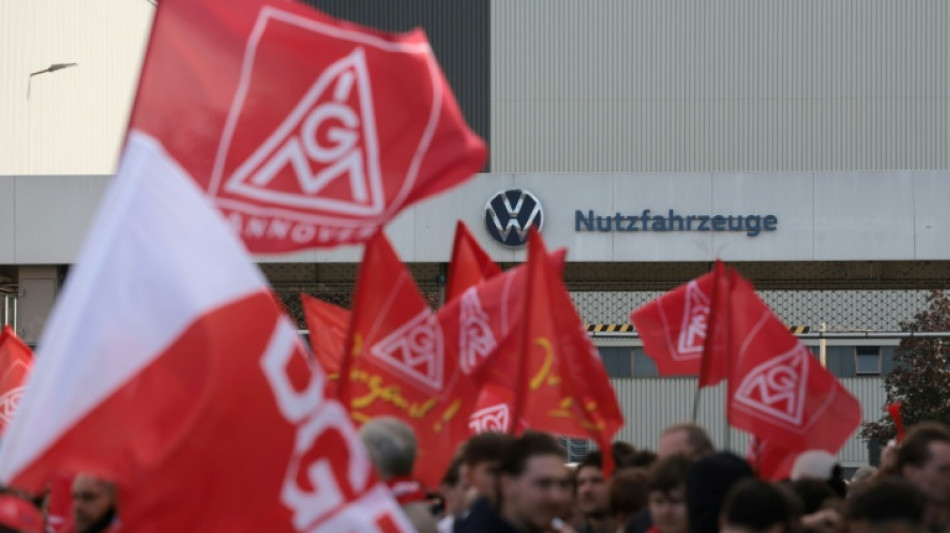
German auto workers stage mass protests in bid to save jobs / Photo: Ronny HARTMANN - AFP
German automotive workers held nationwide protests on Monday calling for government and management action to protect jobs and factories in an industry facing severe headwinds.
Growing Chinese competition, compounded by weak domestic demand and US tariffs, have hit the German car industry hard.
Volkswagen plans to cut 100,000 jobs by the end of the decade, the biggest restructuring ever in global automotive history. Mercedes-Benz and BMW are also downsizing.
Almost 180,000 people took part in the protests at over 280 sites across Germany, the IG Metall union said.
Janik Hitzemann, 31, an assembly line worker at a VW plant in Hannover -- one of four in Germany that have been slated for potential closure -- told AFP he was protesting to pressure management to find another use for the site.
"All we really want is for the board to take our demands for an alternative solution seriously," he said.
"Losing your job would be devastating for the individual concerned," he added.
Speaking at VW's iconic Wolfsburg factory, the largest in the world by floor area, IG Metall leader and VW supervisory board member Christiane Benner said: "Things have really hit the fan."
"Companies like VW, BMW, Audi, Bosch, Mercedes and Porsche were synonymous with fantastic cars and high quality," she said.
"Now, management is driving the industry at full throttle into a brick wall."
Many blame the industry's woes on management for starting too late with the transition to electric vehicles and being too slow to invest in software.
Others point to Chinese government support for its domestic carmakers, which many in Europe say has unfairly led to overcapacity in the global car industry.
German Finance Minister Lars Klingbeil said last week he would press for the European Union to further protect the continent's carmakers from Chinese competitors, saying it was important to not be "naive".
Speaking on Monday, Benner called on the government to make energy cheaper, provide financial help for suppliers that need to retool factories, and promote domestic production with "Made in EU" rules.
"Colleagues in these tumultuous times need to be able to count on the protection of comprehensive welfare and industrial policy," she said.
- Painful truths -
Also speaking at Wolfsburg, Daniela Cavallo, the head of VW's works council, told colleagues some "painful" truths.
"Europe's automotive industry will be remade," she said. "Long-established carmakers will fall by the wayside. Others will have to merge."
"The battle over how to share the burden has already begun," she added. "The question is not what we as employees will be asked to take, but rather how we collectively can distribute sacrifices fairly amongst ourselves."
Wolfgang Schroeder, a political scientist at the University of Kassel who researches labour relations, told AFP the protests reflected deep worry over the future of the automotive industry.
"A nationwide action that is not related to pay negotiations or to specific disputes with companies but to a whole sector and its problems, that's rather new," he said.
"It's the expression of real fear over the future of the industry."
C.Ricci--GdR