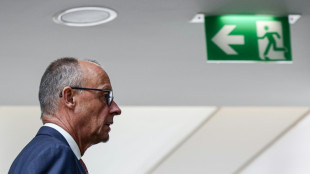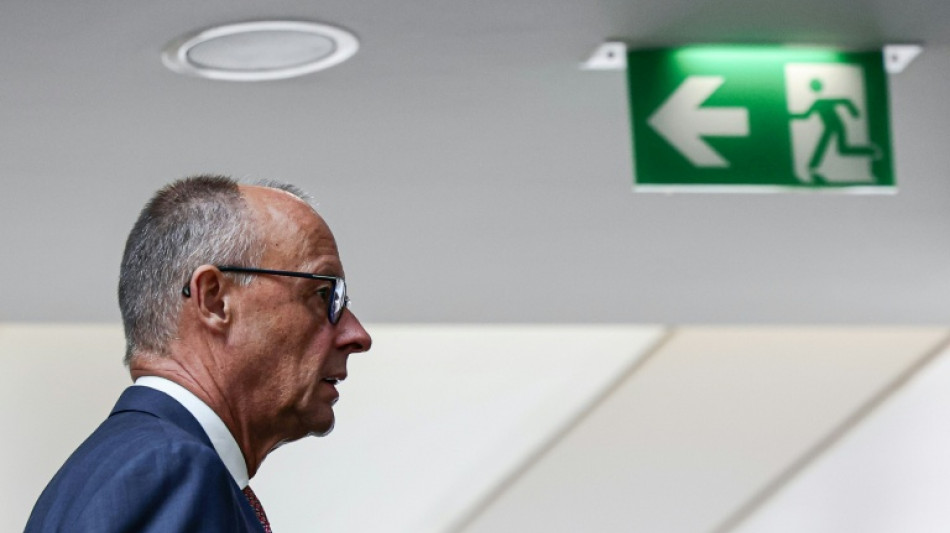
Pressure grows on Germany's Merz after election defeats / Photo: Jens SCHLUETER - AFP
German Chancellor Friedrich Merz faced growing pressure Monday after bruising regional election defeats to far-right and far-left parties, with the AfD even predicting he will be out of power within months.
The anti-immigration Alternative for Germany (AfD) came first Sunday in the northeastern state of Mecklenburg-Western Pomerania where Merz's CDU sank to 4.9 percent, below the threshold to stay in parliament and its worst result since the party was formed in 1945.
In Berlin the far-left Die Linke came first, beating the CDU into second place. Its candidate is now on course to become mayor in the German capital, where the AfD also made strong gains.
The setbacks came with speculation already at fever pitch about Merz's future after the AfD -- which has been ahead of mainstream parties in nationwide surveys for months -- scored its biggest electoral triumph yet in a vote in Saxony-Anhalt state on September 6.
The AfD's top candidate in Mecklenburg-Western Pomerania, Leif-Erik Holm, said Monday he did not believe Merz, who is deeply unpopular after just 16 months in office, would last much longer in his post.
"The chancellor certainly won't make it to the end of the year," Holm predicted at a Berlin press conference. "I think the twilight of the chancellor's era has begun."
Fighting speculation that his CDU/CSU bloc may try to oust him, the 70-year-old Merz took the unusual step Sunday of addressing the nation on TV just minutes after the first exit polls were announced.
Merz admitted that his CDU had suffered a "disaster" in Mecklenburg-Western Pomerania but vowed to stay the course, push on with reforms and govern with "backbone, steadfastness and patience".
Despite the AfD win there, the centre-left SPD party looks set to continue governing the state if it can form a coalition with left-wing allies.
- 'Defensive position' -
Analysts saw Merz's unexpected appearance as an attempt to gain the advantage before another hailstorm of criticism.
"His extremely early move shows that Merz is staking a claim to define the narrative," political scientist Oliver Lembcke of Ruhr University Bochum told AFP.
Lembcke labelled this "leadership from a defensive position -- and an attempt to prevent a personnel debate with an uncertain outcome from gathering steam."
The chancellor has also cleared his calendar for the following days and skipped a trip to New York for the UN General Assembly to deal with potential aftershocks from the votes.
When Merz took office in May last year, he vowed to reboot a flagging economy, rebuild the military to deter Russia and reduce irregular immigration to soothe voters' fears and lure them away from the AfD.
But his personal approval ratings are hovering just above 10 percent, with reforms moving slowing and Europe's biggest economy still struggling to get back on its feet.
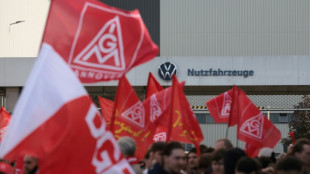
Highlighting the economic woes, tens of thousands of auto workers staged protests nationwide Monday demanding more action to protect jobs, following waves of cuts at top carmakers like Volkswagen and their suppliers.
- 'Things can't go on' -
Sunday's election losses also looked set to cause more turbulence between the CDU and their junior coalition partners, the centre-left SPD.
While SPD leaders pledged to remain in the coalition, they hinted that they wanted to reopen talks on social and economic reforms, recently agreed on after months of often rancorous negotiations with the CDU.
"We stand by this coalition," said Finance Minister Lars Klingbeil, who is the SPD's co-leader.
But he added that "things can't go on" as they had been.
"We need open and honest debates, including within the government, about the course of reforms," he added.
Merz has been fighting off rumours he may be ousted for weeks.
Names of hopefuls for the top job that have been floated include Hendrik Wuest, state premier of populous North Rhine-Westphalia, and Markus Soeder, the Bavarian state premier and head of the CSU, the regional sister party of the CDU.
However, no contender has made an open move for the job -- perhaps fearing the act of disloyalty could backfire, or intimidated by the tough task of trying to revive the conservatives' fortunes during one of their worst-ever crises.
V.Colombo--GdR