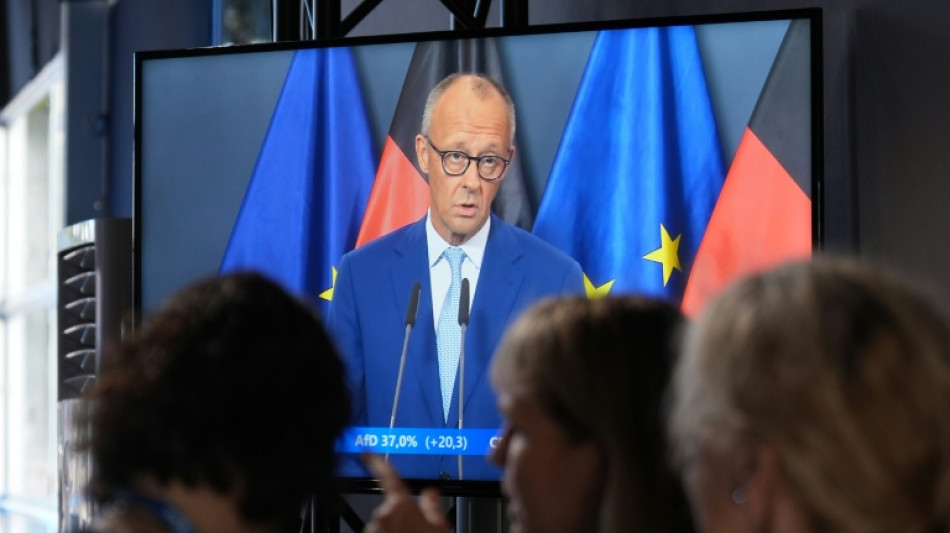
Germany's Merz shaken by far-right and far-left gains in state votes / Photo: Marcus Brandt - POOL/AFP
The far right and far left had more success in German state elections on Sunday, dealing yet another blow to embattled Chancellor Friedrich Merz -- who has vowed to stay the course.
The far-right Alternative for Germany (AfD) scored 37-38 percent in the northeastern state of Mecklenburg-Western Pomerania against 35.5-36.5 percent for the centre-left SPD, according to exit polls by public broadcasters ARD and ZDF.
Merz's centre-right CDU hovered just above five percent there, the point where it would crash out of parliament -- an outcome Merz admitted was a "disaster".
In Berlin, the far-left Die Linke party with 24.5-26 percent looked set to easily defeat the CDU, which is currently running the coalition government and which scored 20 per cent, according to exit polls.
Merz -- who had called a crisis meeting of his party leadership in anticipation of a poor result -- quickly stepped before the cameras and vowed to stay the course, following recent speculation he may soon be ousted by his party.
"The reforms have to come," 70-year-old Merz said. "I am taking on this responsibility because I want to move our country forward."
The AfD also won 16 percent in Berlin, although it looked set to remain shut out of power in both states because of a "firewall" of non-cooperation agreed by other major parties.
- Poor approval ratings -
Merz -- with record low personal approval ratings after 16 months in office -- has been fighting off rumours he may be ousted by his centre-right CDU/CSU bloc.
On election night, he was huddling in a crisis meeting of the CDU party leadership to discuss the outcome of the regional polls.
The chancellor has also cleared his calendar for the following days and skipped a trip to the UN General Assembly to deal with potential aftershocks from the votes.
The latest polls came two weeks after the far-right, pro-Trump and Moscow-friendly AfD dealt a stunning defeat to the CDU in the state of Saxony-Anhalt.
Sunday's Berlin election was a historic first for Die Linke, which promises drastic steps to solve a housing crisis in the German capital, including expropriating flats held by large corporate landlords.
A CDU defeat there, if confirmed in final results, is another black eye for Merz -- especially at the hands of its nemesis Die Linke, which opposes big business, rejects military aid for Ukraine and wants Germany to exit NATO.
- Call for 'stability' -
When Merz took office in May last year, he vowed to reboot a flagging economy, rebuild the military to deter Russia, and reduce irregular immigration to soothe voters' fears and lure them away from the AfD.
But the AfD now leads nationwide polls and Merz's personal approval ratings hover just above 10 percent, not helped by his occasionally blunt and abrasive comments.
The string of election debacles come as Merz has struggled to push through promised economic and social welfare reforms with his centre-left coalition partners the SPD.
Under-fire Merz received some badly needed support from CDU powerbrokers on Wednesday when eight state premiers declared jointly that Germany needs "stability now more than ever" rather than "discussions about personnel".
They refrained, however, from issuing a personal endorsement for Merz.
G.Lombardi--GdR