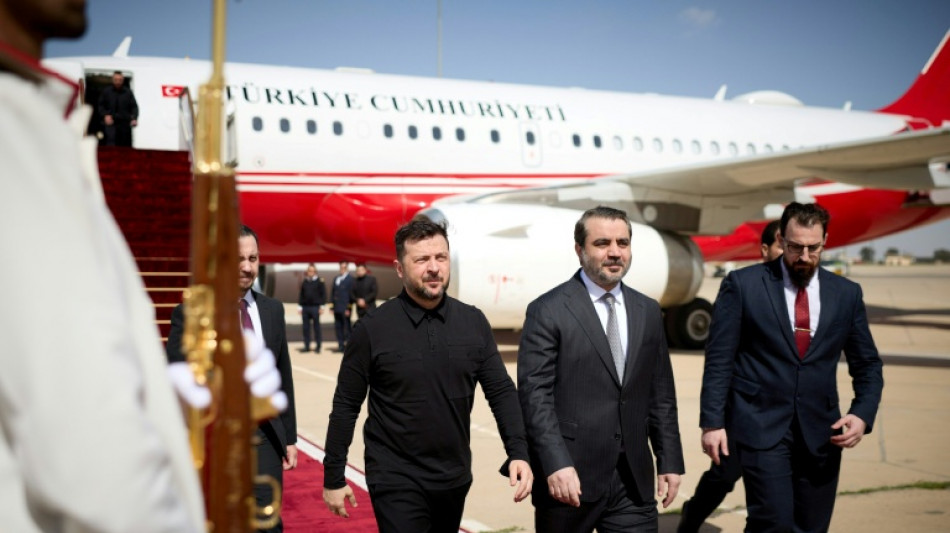
Kyiv books tentative diplomatic coup with Iran war forays / Photo: Handout - UKRAINIAN PRESIDENTIAL PRESS SERVICE/AFP
When the US-Israeli war with Iran began at the end of February, it was widely assumed that Moscow would be one of the conflict's key winners.
Higher oil prices, a distracted Washington and a sudden need for Western air defence systems in the Gulf were seen as a boost to Moscow's four-year invasion of Ukraine.
But in Kyiv, officials and analysts say a flurry of high-level visits by President Volodymyr Zelensky and the inking of security accords across the Middle East amount to a diplomatic coup that have given the embattled country outsized clout in a region recently seen as aligned with Russia.
"Ukraine is for the first time -- and to some countries' surprise -- acting as a state that can provide security services, that can, as experts say, export defence and security expertise," Volodymyr Fesenko, a respected political observer in Kyiv, told AFP.
That is a marked turnaround from 2022 when an under-equipped Kyiv went on bended knee to the United States and Europe to appeal for sophisticated air defence systems, advanced battle tanks, and as many artillery shells as they could get their hands on.
The rapid proliferation of drones has made many of those weapons less relevant, and spurred Ukrainian rag-tag arms producers to become global leaders in drone warfare and anti-drone systems.
- 'Moscow extremely upset' -
Kyiv's forces neutralise hundreds of the Iranian-designed drones launched by Russia every day, and as Iran started firing off drones across the Middle East in retaliation for the US-Israeli attacks, Zelensky quickly deployed more than 200 of his anti-drone experts to at least four states.
Zelensky himself paid high-profile visits to Saudi Arabia, the United Arab Emirates, Qatar, Jordan and Syria -- becoming one of the first foreign leaders to visit the region during the war.
"Moscow is extremely upset with Ukraine's rapid strengthening of ties with the Gulf countries in the wake of Iranian air terror," Ukrainian Foreign Minister Andriy Sybiga said on social media.
"They understand that Ukraine's unique experience has dramatically changed its role in the region," he added.
Sybiga said Russia and its close ally Iran had taken to spreading disinformation about Ukrainian anti-drone units to undermine Kyiv's diplomatic reach -- like that Iran had struck a depot housing Ukrainian anti-drone systems in the United Arab Emirates.
Despite Ukraine managing to give itself a surprise role in the conflict, the question remains what material benefit it can extract besides some good publicity.
"Frankly, in the Gulf countries you can simply ask for money," political analyst Taras Zagorodniy suggested to AFP in a telephone interview.
"This is a way to scale our own technologies and attract additional resources, because we need money to support our technologies and investments," Zagorodniy, Managing Partner of the National Anti-Crisis Group think tank, added.
Details of the defence agreements struck with several states in the region have not been made public.
Zelensky had previously proposed swapping Ukrainian drone warfare technology for the advanced air defence missile ammunition -- though that idea appeared to gain little traction.
- No 'breakthrough' -
The Ukrainian leader has also suggested that improved ties with the Gulf could help place broader pressure on Russia to halt its invasion.
But analysts have warned that these overtures do not amount to a breakthrough -- yet.
For one, the impact of the two-week truce agreed between the United States and Iran is unclear.
Zelensky has said Ukrainian anti-drone units will remain in the Middle East but the long-term demand for Ukrainian war tech remains in question.
The region has largely refrained from criticising Russia's invasion and has not hit Moscow with sanctions. Many states seek good relations with both sides to play a mediating role -- hosting talks or brokering the return of children.
"It is premature to speak of a breakthrough. This is not even a step -- rather a first cautious move in the right direction," former Ukrainian diplomat Vadym Triukhan wrote in a recent analysis.
To be a "game changer" for Kyiv, the pace of engagement needed to be kept up.
"If this tempo is not lost, then within a few months it will be quite realistic to reach multi-year, multibillion contracts," Triukhan wrote.
R.Tedeschi--GdR