Ahead of election, Danish city mirrors country's challenges / Photo: James Brooks - AFP
In the Danish city of Kolding, voters are worried about rising prices, the welfare state and immigration ahead of the country's general election, reflecting nationwide concerns reinforced by worries about Greenland and global uncertainty.
Kolding -- Denmark's eighth biggest city with 64,000 inhabitants -- lies at the intersection of the main road and rail routes linking Jutland, the continental part of Denmark, to the eastern islands where Copenhagen is located.
Campaign posters line the port city's almost-empty streets, dotted with shuttered shops, but the debate is the same as in many towns in the country of six million people that will vote on Tuesday.
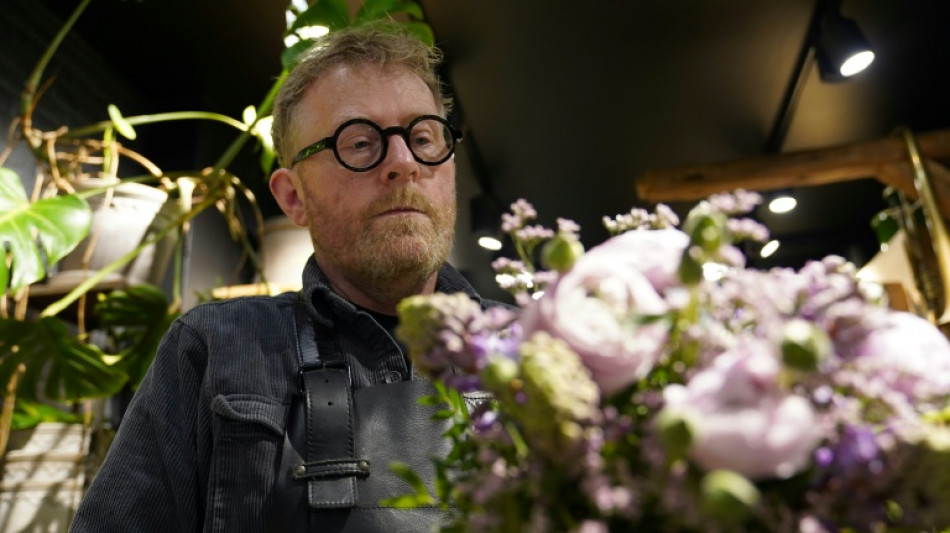
Denmark is one of the world's wealthiest countries in per capita terms. But in Kolding "there are a lot of empty stores," lamented Per Hansen, a 54-year-old florist.
"People don't dare to start something because it's expensive, and a lot of banks are reluctant to loan money to set up a proper business," he said.
Hansen, who opened his store in 2001, hopes the next government will help small businesses, squeezed by online shopping and large shopping centres on the one hand and rising prices on the other.
"Prices are increasing, and sometimes consumers don't understand that the price of flowers is going up," he said.
"The Middle East war is also pushing up the price of oil and fuel, so it costs more for the Dutch truck to bring the flowers to Denmark, and prices will inevitably go up."
Prime Minister Mette Frederiksen's Social Democrats, in power since 2019 and currently leading a left-right coalition, top public opinion polls with around 21 percent of votes, though that is six points lower than their 2022 election score.
Negotiations after the election will determine the shape of the next government.
- 'We're doing okay' -
In Kolding, 42-year-old Afghan Wahida Abdul Mutaleb admitted she's struggling to make ends meet.
"We have to cut back on everything to live."
"But despite everything, we're doing okay," said the mother of four children aged 13 to 20, who makes a point of being involved in the community where the family has lived for 12 years.
In the beginning, she went to the Volunteers' House to learn Danish and get help finding her way in the Scandinavian country.
She now works as a volunteer there herself.
Nearly 400,000 people in the population were born outside the European Union, according to EU figures, but Denmark is known for its tightening of immigration policies in recent decades.
As a Muslim woman in Denmark. Mutaleb said she has "never had any bad experiences".
"When I started taking language classes and I tried to learn a bit of Danish, I was always welcomed with smiles and a lot of patience."
Kolding mayor Jakob Ville, of the liberal Venstre party, told AFP that in national politics, "some parties take very hard lines on refugees and immigrants".
"Those same parties sit here on the municipal council, and in the eight or nine years I've been a member I've never heard a single one of them talk about refugees."
"I think it's because when it comes to (the national) parliament, they speak to people's emotions."
- Pragmatists -
Ville said Kolding residents were pragmatic.
"What's important is that when my mother and father go into a nursing home, they will be able to get the services they need. And I don't care, and my mother and father don't care, whether it's someone who speaks Danish," he said.
But in national politics, parties keep trying to outdo each other: the Social Democrats want to facilitate returns and expulsions, while the far-right Danish People's Party is pushing for what it calls "re-migration", especially of Muslims.
The head of the Volunteers' House, Margit Vestbjerg, said some migrants, in particular Syrians, "feel increasingly insecure".
"Their right to stay here is being called into question," she noted.
"There is constant talk of temporary residence. And there are also more and more politicians who openly talk about sending them back home," she added.
Michael Jensen, who said he was a lifelong Social Democratic voter, believes Denmark's integration policy has failed.
"It's certainly not gotten any better. It's actually gotten much worse," he grumbled.
Meanwhile, the city's mayor attributed the concerns of Kolding people to broader geopolitical issues, such as the Ukraine war and US President Donald Trump's demand to take over Denmark's autonomous territory of Greenland.
"There is a kind of anxiety in our society at the moment," he said.
"During the campaign for the municipal elections in November, many people started asking: 'Where are our shelters? Where could we go?' I had never heard that question before."
M.Russo--GdR