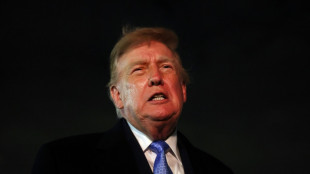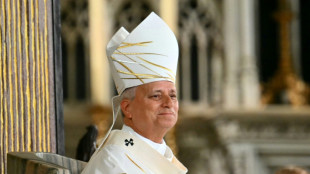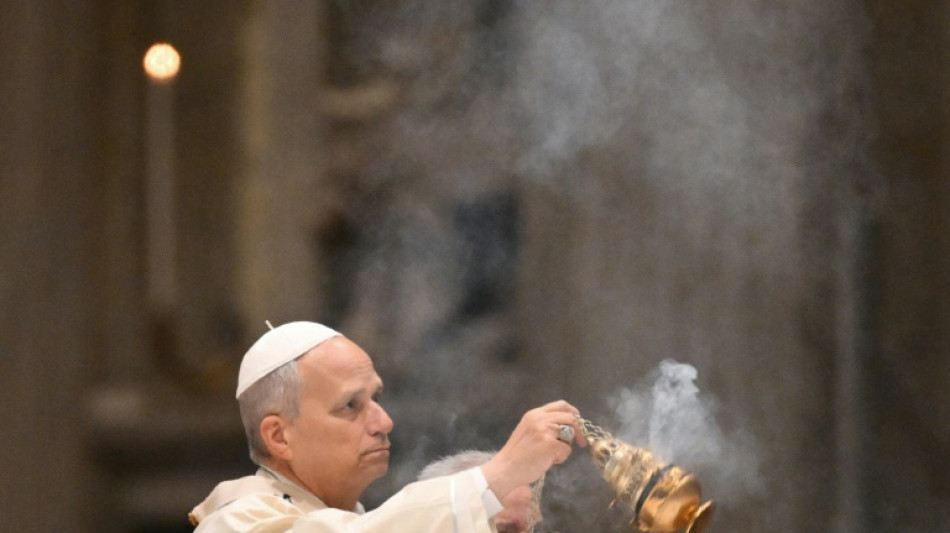
Faced with Trump, Pope Leo opts for indirect diplomacy / Photo: Alberto PIZZOLI - AFP
Faced with a highly polarised US political landscape, Leo XIV, the first American pope, has opted for discreet and indirect criticism while also keeping channels of communication open.
Since he was elected in May, the Chicago-born pontiff has taken a clear stand against some decisions by US President Donald Trump's administration.
He has denounced the "inhuman" treatment of migrants, urged dialogue in Venezuela and lamented a "diplomacy of force".
But, in recent weeks, Leo has favoured restraint.
He has made no reference to a possible US intervention in Iran, nor to Trump's designs on Greenland, nor to the volatile situation in Minneapolis after two protesters were shot by federal agents.
His weekly statements carefully avoid these subjects, while his Tuesday evening comments to the press outside his Castel Gandolfo country residence have become increasingly rare.
He briefly broke his silence on Sunday to voice "great concern" about rising tensions between Cuba and the United States, calling on all sides to "avoid violence".
"Leo is very cautious. He knows his voice is universal. As an American, he is somewhat the natural opponent of Trumpism," a Vatican source told AFP on condition of anonymity.
"On the United States, he's walking on eggshells.
"He understands that the American Church is also targeted by ICE, people are afraid," the source said, referring to the Immigration and Customs Enforcement agency currently in the spotlight for its immigration crackdown.
The pope is operating in a context that is "hyper-polarised, where the Church is also targeted through the populations it helps, like migrants or the Hispanic community", the source added.
- Bishops on the front line -
But despite increasing concerns within the corridors of the Holy See at the Trump administration's actions, the pope prefers to rely on the American Catholic hierarchy rather than wade into the fray himself.
"I think he thinks the first response should come from the country's bishops themselves," Christopher White of Georgetown University in Washington and author of the book "Pope Leo XIV: Inside the Conclave and the Dawn of a New Papacy", told AFP.
Last week, Archbishop Paul Coakley, president of the US bishops' conference, reacted forcefully to the "killing" of Renee Good and Alex Pretti in Minneapolis, denouncing "failures in our society to respect the dignity of every human life".
Bishop Anthony Taylor (Little Rock, Arkansas) pointed to "obvious parallels" between the United States now and Nazi Germany, although he said that "Trump is no Hitler".
"We are doomed to repeat failures of the past if we are not willing to remember them and learn from them," he wrote.
The same approach applies on the international stage: in a joint statement, three leading cardinals -- Blase Cupich (Chicago), Robert McElroy (Washington) and Joseph Tobin (Newark) -- condemned America's interventionist drift, the erosion of the multilateral framework and the risks to world peace.
According to several Vatican sources, the text received Leo XIV's quiet approval.
- 'Reputation' -
At the end of December, the Vatican Secretary of State, Italian Cardinal Pietro Parolin, tried in vain to dissuade Washington from launching a military operation in Venezuela during a meeting with the US ambassador.
"The aim was to avoid a bloodbath and bring the actors back to reason," a senior Vatican source said.
Invited to Trump's new "Board of Peace" on Gaza, the Vatican is biding its time, saying it is "reflecting" on its response -- another sign of an increasingly deliberate caution.
Leo has yet to meet Trump, although he received Vice President JD Vance two weeks after his election in May 2025.
The challenge is to avoid exacerbating the divisions of an already split American Church and to prevent his words from being read through a partisan lens.
For the Vatican, the broader goal is "to prevent historians from writing in five, 10, or 20 years that the American Church was tied to Trumpism", said Italian historian Massimo Faggioli, a professor at Trinity College Dublin and author of the book "From God to Trump: Catholic Crisis and American Politics".
"The risk is a disintegration, even a collapse, of the reputation and historical role of the American Church," he said.
G.Vitali--GdR