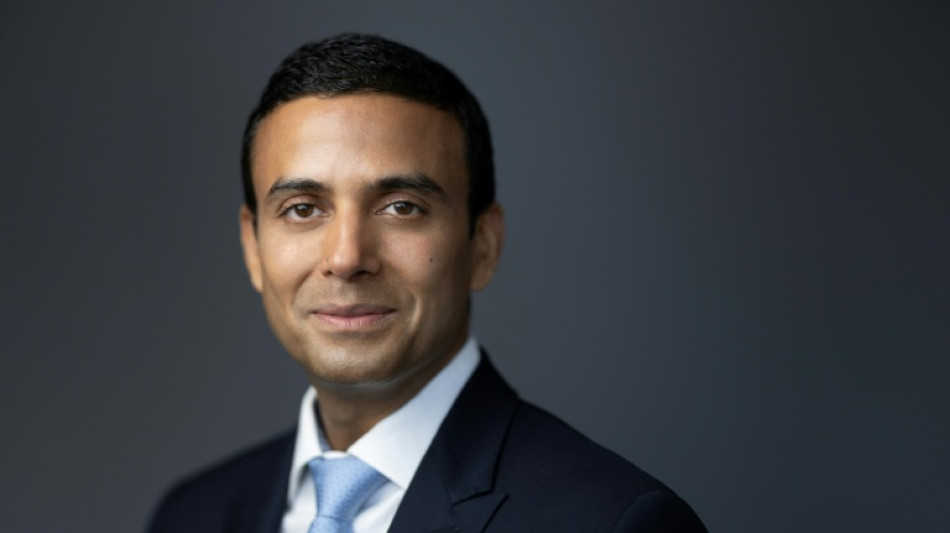
Gagan Gupta, man on a mission to industrialise Africa / Photo: Joel Saget - AFP
From timber and textiles to minerals, Indian entrepreneur Gagan Gupta has spent the past 15 years working to industrialise Africa.
Through his holding company Arise, he has emerged as one of the continent's most influential economic players.
"The kind of industrialisation Africa will see, people can't imagine. It will be massively changed in the next five to seven years, driven by population," said Gupta during a recent interview in Paris.
"Simple things from textiles to high-end things, all 1.4 billion people will need. And instead of being imported, all will get manufactured," he said.
With his friendly smile and understated suit, the 51-year-old businessman is spearheading a series of industrial and logistics infrastructure projects, with the aim of developing sectors for the processing of raw materials.
It was in Central Africa that Gupta, born in the northern Indian state of Rajasthan and originally a management accountant, in the late 2000s joined the race for special economic zones (SEZs) -- sites that were set to spring up all over the continent.
The schemes ease economic regulations such as taxation and customs duties within a given territory to attract investors.
Gupta arrived in Gabon in 2008, aged 33 and with no French, to head the local subsidiary of Singaporean agrifood giant Olam, where he built close ties with the then president, Ali Bongo.
In 2010, he launched the 1,000-hectare Nkok SEZ with the goal of processing timber, one of Gabon's main resources that was mostly exported in raw form.
- 10 million jobs -
His guiding principle is simple: focus on key local resources, process them locally, create skilled jobs, and export value-added products through public-private partnerships.
"To date, we have about 100,000 people that come to work in our zones," he said, referring to those in various African countries of Arise Integrated Industrial Platforms (Arise IIP), one of the entities in the pan-African group founded by Gupta.
Under his leadership, Benin, traditionally a cotton producer, is entering the textile industry.
With spinning, weaving, dyeing and knitting facilities -- the Glo-Djigbe site exported its first garments in 2024 for the French retailer Kiabi, followed by other international brands such as US Polo.
While sub-Saharan Africa imports over $30 billion worth of textiles per year, the businessman is developing this industry in other countries such as Togo, Nigeria and Kenya.
"If those billions were produced locally, you're talking of direct jobs -- up to 10 million people," said Gupta.
Arise IIP, which says it has secured nearly $2 billion in cumulative investment, announced a fresh $700-million fundraising round in September 2025.
The Saudi firm Vision Invest joined its shareholder base alongside financial institutions such as the Africa Finance Corporation (AFC), the majority shareholder, and Gupta's own investment fund, Equitane.
- 'Just starting' -
Inspired by successes in Asia, SEZs have seen rapid growth in Africa in recent years, with more than 230 in 2025, according to a study by the French Development Agency.
They "enable companies based on the continent to diversify their markets, produce more sophisticated goods and penetrate markets that were previously inaccessible", the report's author, Julien Gourdon, told AFP.
But their long-term viability "depends in part on their (good) relations with those in power", and "some outcomes remain difficult to measure, particularly in terms of local job creation", the economist warned, with the risk benefits go to skilled foreign workers.
Arise has repeatedly denied accusations of fraud and/or corruption in the awarding of public contracts, notably in Gabon and Chad.
Other criticisms levelled at Gupta include generous tax incentives and streamlined administrative procedures granted to investors, which critics argue deprive African states of much-needed revenue.
The businessman -- whose surname is common in India and is no apparent relation to the Gupta brothers accused of graft in South Africa -- brushed off these allegations.
"If I were to come and say in France -- or elsewhere -- I want to invest a billion dollars, don't you think I'll be talking to the government? Why should it be any different in Africa?" he said.
Gupta continues to expand on multiple fronts: in the energy sector through Spiro and in mining, including for iron ore in Gabon, bauxite in Cameroon, gold in Mali and elsewhere through Africa Middle Metal Processing Platform (A2MP).
"Global production plants will soon be set up in Nigeria and Kenya to manufacture lithium-ion batteries," he said.
Before boarding his jet for China, where these batteries have so far been produced, Gupta pledged: "Our industrial transformation journey is just starting."
P.Caruso--GdR