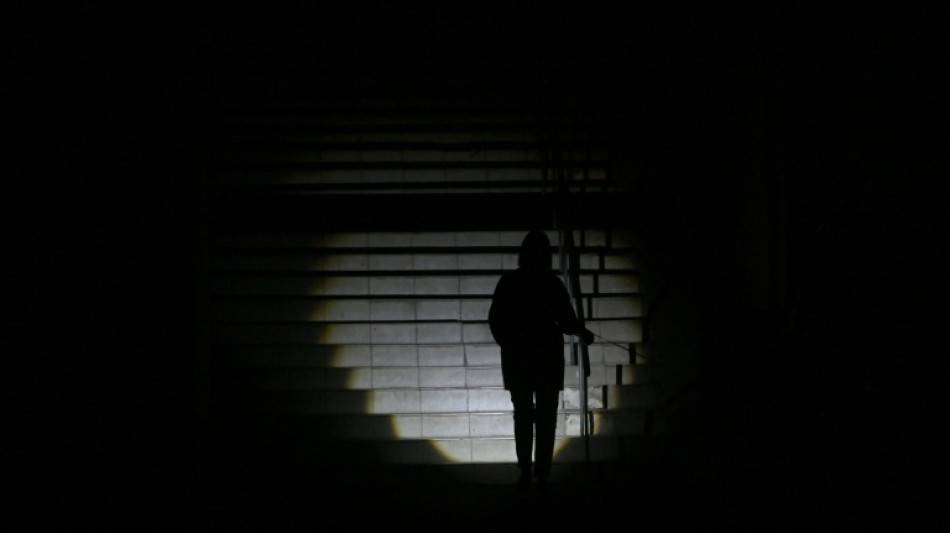
Ukraine races to secure energy supplies ahead of winter / Photo: Sergei SUPINSKY - AFP
Hardly a day goes by now in Ukraine without news of another Russian air strike on the country's energy sector, causing widespread blackouts, including in the capital, Kyiv.
President Volodymyr Zelensky said on Sunday that Moscow targeted electricity and oil and gas facilities 76 times in the week since Donald Trump announced a supposed "energy ceasefire".
On Monday, he said "more than 10 energy infrastructure facilities were damaged, and the lights went out for at least 550,000 families" after attacks overnight.
Kyiv says it initially held off responding in kind but has since resumed its own strikes.
Last winter, Russian strikes knocked out power and heating in sub-zero temperatures. As the big freeze approaches again, Ukraine is racing to make sufficient repairs to the battered grid in time.
Rolling power cuts are one way of easing pressure but there is no quick fix.
The World Bank said in February that the long-term bill to restore Ukraine's energy sector is estimated at about $91 billion.
Some $4.9 billion is needed for urgent repairs this year alone.
With no let-up in attacks, Olena Pavlenko, head of the DiXi Group energy think-tank, said that figure could well be an underestimate.
"I am sure that with the level of attacks and destruction, the number just for 2026 will be around $6-7 billion," she told AFP.
- 'Destroyed' -
Kyiv city is served by three combined heat and power (CHP) plants with a total generation capacity of some 1.3 gigawatts, according to Global Energy Monitor, an NGO.
Mayor Vitali Klitschko said this month that the city's capacity to generate electricity had been "destroyed", despite repairs since last winter.
"Information about the level of damaged capacity is not publicly available but we assume that most of the CHPs are fully destroyed again," said Pavlenko.
"Distributed generation will not be enough to cover the needs. The city team and government still have some time to repair the facilities before the temperature drops.
"But in case of another attack, the situation will repeat."
Kyiv's hulking CHPs date back to the 1970s and 1980s during Soviet times, and the stock of replacement parts to patch up damage is running low.
Power company DTEK said on October 1 that its thermal power plants have been attacked more than 230 times since the start of the conflict.
Vitalii Zaichenko, from grid operator Ukrenergo, said last week that recent ballistic-missile and drone strikes have made energy workers' jobs "significantly more difficult".
"Having previously targeted high-voltage substations and generation facilities, the enemy has now shifted to directly attacking high-voltage transmission lines," he explained.
Quickly arranging back-up power is "extremely difficult", and the networks of distribution companies are also being targeted.
Air raid alerts, which sound around the clock and can last hours, complicate repairs, he added.
In Kyiv, which is home to some three million people, Zelensky has openly criticised Klitschko for the pace of winter contingency planning.
But the mayor insists that back-up plans will be in place, with generators provided at schools and medical facilities for light, heating and hot water.
- Decentralisation -
The International Energy Agency (IEA) watchdog has said that Ukraine had about 38 GW of generating capacity before Russia's full-scale invasion in February 2022.
But nearly five years of war has seen that dramatically slashed, although the current generating capacity remains unclear.
Currently, Ukraine's three still-operational nuclear power stations are supplying more than 55 percent of the country's total electricity production.
Decentralising energy provision through local generation, battery energy storage, microgrids and cogeneration have all been proposed to boost the supply, but time is not on Ukraine's side.
A lack of stable electricity in the grid has already seen the temporary suspension of Kyiv's Metro system and there are fears that water supplies could also be hit.
"If there's no electricity in the city, there'll be no water," said Sergii Gorkutsenko, deputy chief executive of Kyivvodokanal, the city's main water supply provider.
Limiting power through planned cuts or emergency outages will hit the utility's ability to pump water, including to high-rise apartment blocks, he told epravda.com recently.
Kyiv residents have already seen their taps run dry and this, plus the ability to take away wastewater, is causing public health fears.
"If there's no sewage, in three days there'll be an epidemiological catastrophe," said Gorkutsenko.
F.Villa--GdR