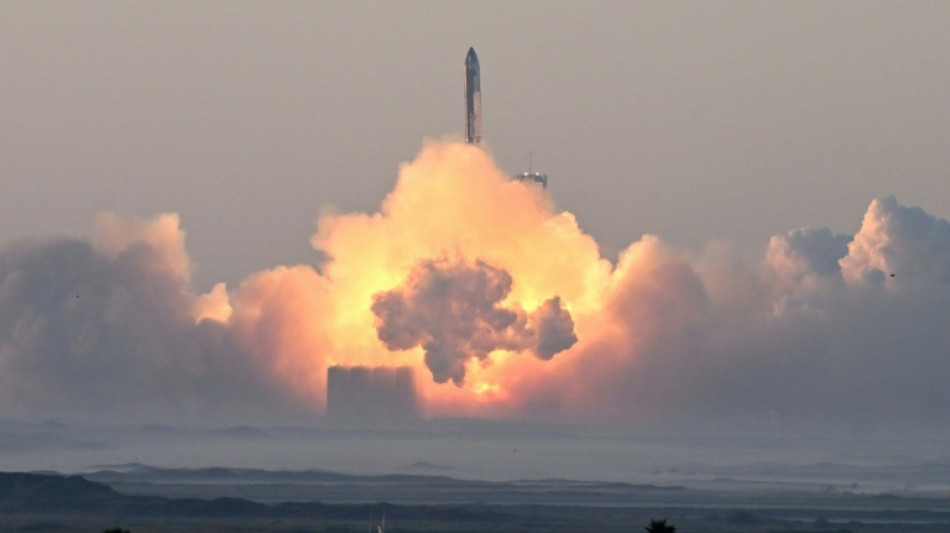
Science fiction? Musk's lofty SpaceX goals unrealistic, skeptics say / Photo: TIMOTHY A. CLARY - AFP
Elon Musk's SpaceX has made awe-inspiring achievements since its founding over two decades ago and has big ideas -- colonies on Mars, orbital AI data centers, rapidly reusable rockets -- for the future.
But as SpaceX makes its record-breaking public market debut, some experts express doubts it can reach its lofty goals, especially on its planned timeline.
"We achieve what others think is really the impossible, and we make that possible," CFO Bret Johnsen said in a recent video.
Indeed, the company's development of a partially reusable rocket -- which has allowed it to conduct more launches than all other providers combined -- was once thought unattainable.
"SpaceX has accomplished a great deal, that's quite real," Robert Zubrin, an engineer and president of the Mars Society, told AFP.
"On the other hand, Musk frequently makes claims that are not real," he said, citing deadlines that are regularly pushed back.
- Fairytale timelines -
While many experts believe they will see SpaceX send humans to Mars in their lifetime, the prospect of a mass inhabited colony will take much, much longer -- if ever.
"The simple answer is that I don't see this as realistic at all," said Christian Bach, head of the space transportation division at Germany's Technical University of Dresden and co-author of a critical analysis of Musk's Mars plans.
He said that even just settling a handful of people on the Red Planet is unlikely this century due to unsolved technological and biological challenges.
To make the roundtrip journey to Mars, which takes about three years, Musk and Spacex are counting on their newest rocket under development: Starship.
However, perfecting launches with Starship will not be enough, warns Scott Hubbard, a former senior NASA official. Astronauts will also need new life-sustaining systems, such as oxygen and water recyclers.
"They like to portray it that they can do it on their own, they cannot," said Hubbard.
He believes NASA -- which is planning future missions to explore Mars but not to colonize it -- will have to join the project for it to become a reality.
SpaceX also faces a major hurdle, Hubbard noted, over its goal of refuelling rockets in-orbit.
The idea would be to launch several rockets, one carrying crew or cargo, and the others carrying tanks of liquid oxygen and liquid methane that would be offloaded through coupling.
That capability "is something that is absolutely crucial to their plans that has never been done before," he said.
"They have extraordinarily good engineers...so they will solve the problem, the thing is the schedule," he added.
- New-age Napoleon? -
SpaceX has other major projects on its plate -- including building a modified Starship to use as a lunar lander for NASA's Artemis program, and developing a new satellite constellation to serve as orbital AI data centers.
While the idea of moving energy-intensive AI data centers off-Earth may sound appealing, most experts remain skeptical.
"If you do conquer all the technical hurdles, there's still the economic aspect, and it's just not financially reasonable at this point in time," Kathleen Curlee, a space analyst at Georgetown University, told AFP.
Zubrin was more blunt: "This AI data centers in space thing is fiction," he said.
"If you owned a company that could build ocean ships better than anyone else, you would say the place to do AI is in the middle of the ocean," he quipped.
Thanks to the unprecedented influx of cash from SpaceX's IPO, the company will nonetheless have plenty of resources to devote to the project and others.
While flying high for the moment, SpaceX could still face unexpected turbulence -- as evidenced by competitor Blue Origin's recent launchpad mega-explosion.
Zubrin linked Musk's potential for failure to French emperor Napoleon Bonaparte's calamitous campaign in Russia.
If he were to fail, Zubrin said, it'd be because "he had succeeded in everything he had done before, and so no one could tell him that he was wrong."
P.Vincenze--GdR