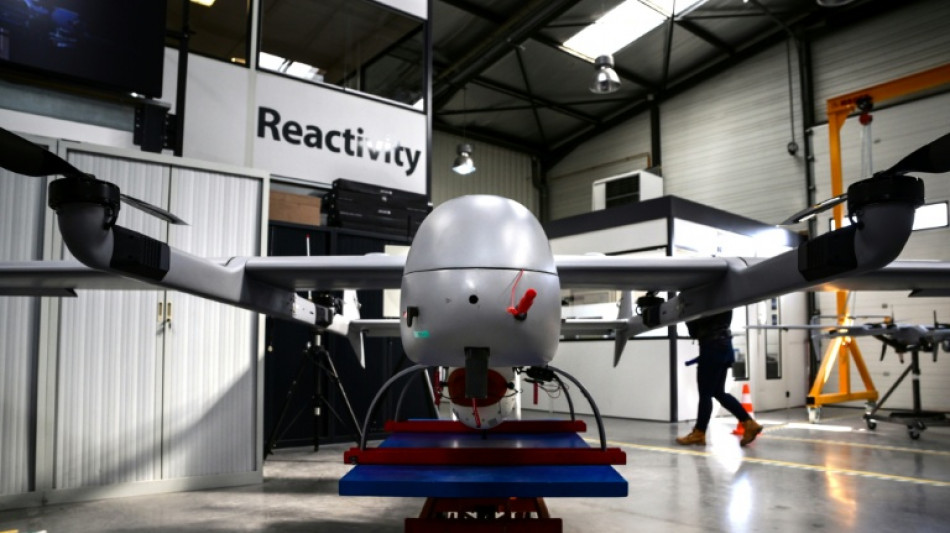
Airbus bets on copter capability for tomorrow's war drones / Photo: OLIVIER CHASSIGNOLE - AFP
In the heart of southeastern France, aerospace giant Airbus is drawing on its helicopter expertise to develop drones -- a core element of modern warfare -- and enable them to work in tandem with manned aircraft.
A small, isolated hangar at Pierrelatte airfield in France's Drome region bears the name Survey Copter, a French venture integrated into Airbus, which is expanding its facilities to prepare for a doubling of production rates by 2027.
"This is a key focus area" given "the lessons learnt from the war in Ukraine and the rearmament drive in Europe. In this context, there is a need for all kinds of drones," Emmanuel Huberdeau, spokesperson for Airbus Helicopters division, told AFP.
The division recently took over management of tactical drones developed by the European aerospace firm.
The Pierrelatte site makes Aliaca, a light 25-kilogramme (55-pound) drone with six hours of autonomous flight for surveillance and short-range reconnaissance.
The model is already in service with the French Navy. A heavier model, the 120-kilo Capa-X -- which can operate for 10 hours on similar missions but also alongside manned aircraft -- is currently awaiting contracts.
Twenty Aliaca and 10 Capa‑X are slated for production this year, with 2027 seeing a doubling as staffing rises from 60 to 80 amid a two-million-euro ($2.3-million) investment in a new hangar, site director Christophe Canguilhem told AFP.
Tuesday was to see a hardware demonstration for the media -- but strong winds prevented that.
"When there's no wind or storm, not a week goes by without flights taking off from here. The hangar door opens right onto the runway. That's a real competitive advantage," said Canguilhem.
- Reusable -
Drones have transformed the war in Ukraine, and now in the Middle East, where Western forces are vulnerable to Iranian-made Shahed suicide drones already in extensive use by Russian forces in Ukraine.
"Ukraine has shown us it is possible to manufacture low-cost drones in large quantities," said Huberdeau.
But for its hardware, Airbus is focusing "added value" on more complex and integrated systems.
"There's also a need for certain non-disposable drone missions, capable of operating in challenging environments... that will be able to return or carry out missions further afield," he added.
"It makes sense for Airbus Helicopters to explore solutions for the armed forces," said Pascal Fabre of the AlixPartners consultancy.
"It's easier when you are Airbus than when you're a start-up."
- 'Solution for the future' -
Airbus's strategy essentially involves fusing cooperation on drones and copters, said Victor Gerin-Roze, programme director at Airbus Helicopters.
"We're convinced drones will greatly enhance the capabilities of helicopters.
"It is a solution for the future," he told AFP.
Tested in Singapore in January, the system lets a copter crew launch a drone, control it from the cockpit and receive live footage to locate an area or a target without putting themselves at risk.
The copter-drone symbiosis will also come into effective play in civilian, firefighting or police missions, said Gerin-Roze.
Up against US firms Boeing, Sikorsky (Lockheed Martin) and Bell (a subsidiary of Textron), the Airbus approach has the crew pilot drones directly from the helicopter.
Its competitors' drones remain a tool linked to the copter but not truly integrated.
Airbus is also exploring development of unmanned copters-as-drones.
For example, the French navy uses the VSR700 drone derived from the small Cabri G2 helicopter for surveillance and reconnaissance.
Airbus is also working on an unmanned version of the H145 helicopter, known as the Lakota in the United States, for the US Navy, a major customer for the conventional model.
It is due for delivery by 2030.
F.Villa--GdR