Fearing Russian strike, Kyiv's Holodomor museum evacuates exhibits / Photo: Genya SAVILOV - AFP/File
In a dark hall of Kyiv's Holodomor museum, four men were carefully lifting the protective glass cases off robes, icons, books and metal agricultural tools.
The items are a memory to the millions that perished in the 1932-33 manmade famine under Soviet dictator Joseph Stalin, which many in Ukraine and around the world call a genocide.
But with Russia stepping up its attacks on Ukrainian cultural and historic sites, the museum is just one institution fearful it could be targeted -- and is now packing up and relocating its collections.
"As the experience of recent weeks has shown, Russia is deliberately striking sites connected to cultural heritage and cultural institutions," the museum's deputy general director, Olga Melnyk, told AFP.
Most of the pieces being relocated to "safer locations" are family heirlooms from victims of the famine, passed down through generations -- often at personal risk during the Soviet era -- Melnyk explained.
Ukraine says nearly 2,000 cultural heritage sites and 2,500 cultural institutions have been damaged since Russia invaded in 2022.
In June, Russian drones crashed into the Pechersk Lavra, a UNESCO-protected 11th-century monastery, setting the roof of its central Dormition Cathedral ablaze.
The Kharkiv Art Museum -- home to one of Ukraine's oldest collections -- a major gallery in Dnipro and film studios in Kyiv were also hit in the strikes.
Earlier this year, the historic centre of Lviv in the west of the country was hit by a brazen drone strike during the middle of the day.
- 'Destroy our heritage' -
When Russia invaded in 2022, there was a rush across Ukraine to board up and protect museums, famous artworks, monuments and statues.
As troops advanced in the east and south, larger pieces were dismantled and shipped across the country.
Ukraine's entry to the Venice Biennale this year was an "Origami Deer" statue rescued from Pokrovsk, a city destroyed and now occupied by Russia.
Recent attacks have spurred a new wave of evacuations.
"Many museums currently no longer display their permanent exhibitions and instead present temporary exhibitions," Deputy Culture Minister Ivan Verbytsky told AFP.
His department has been working to audit potential storage facilities across the country.
Russia denies specifically targeting cultural sites.
It called the hit on the Kyiv cathedral the result of a misfiring US-made air defence missile operated by Ukraine's army.
But for Verbytsky, years of statements from Russian officials repeatedly denying or questioning Ukraine's right to exist as an independent state are proof that the attacks are "deliberate".
"Their purpose is to destroy our heritage and eliminate the material evidence of Ukraine's thousand-year history and of our distinct, authentic culture."
Speaking to AFP from the Holodomor museum's hilltop concourse, overlooking the Dnipro river and much of Kyiv below, Melnyk also pointed to Russia's stated position as grounds for extra precaution.
Russia's President Vladimir Putin vehemently rejects that the famine was a genocide against the Ukrainian people.
"Given that the Holodomor is a particularly sensitive issue for Russia, and that Russia has built many of its narratives around denying the Holodomor as an act of genocide, we cannot rule out the possibility that our museum could become the target of a Russian attack in the near future," Melnyk said.
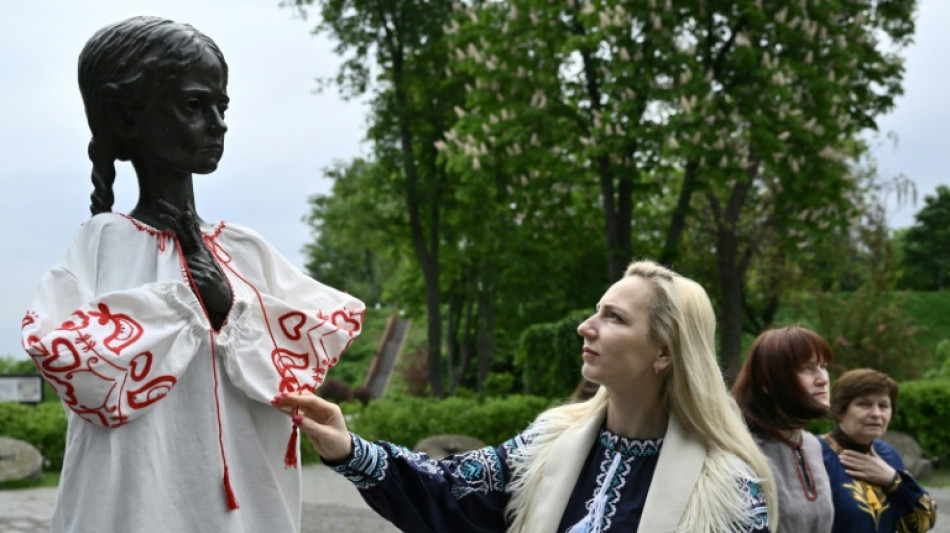
Behind her stood an iconic statue to the famine -- a little girl with braided hair clutching ears of grain, her face in pain.
For now, she was staying in place.
G.Lombardi--GdR