On All Saints' Day, Philippine mountain town honours dead with fire / Photo: Ted ALJIBE - AFP
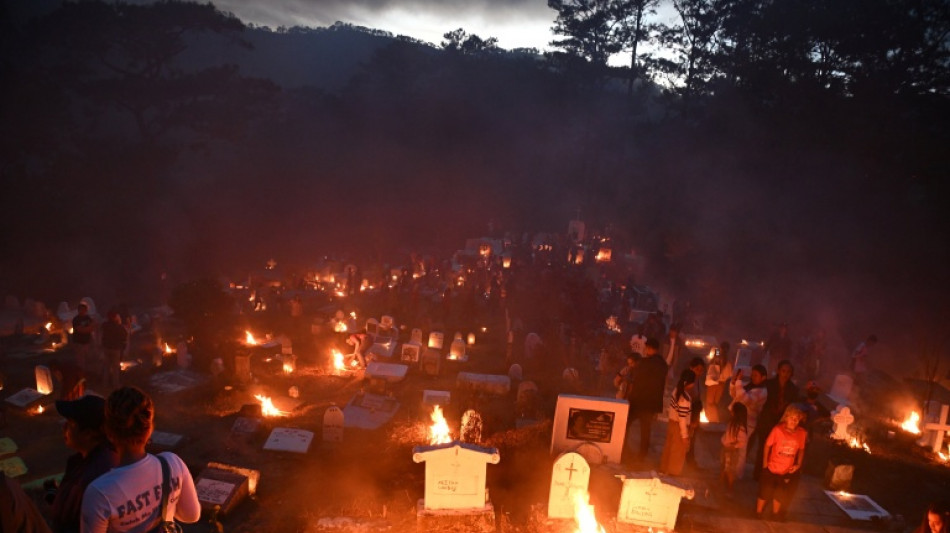
Tiny pinewood bonfires burned through the night at a mountain cemetery as the largely Christian Philippines remembered its dead, turning the fog-shrouded hilltop into a vast, fragrant altar of light.
The eerie Panag-aapoy ("to light a fire") ceremony in the tourist town of Sagada has marked All Saints' Day for the past 122 years, said Winston Garlejo Menong, director of the Episcopal Church of Saint Mary the Virgin, which owns the cemetery.
As night crept in and darkness blanketed the four-hectare burial ground, the hum of activity and thick smoke gave way to a sepulchral glow as fires burned for its more than 2,000 dead.
The Cordillera mountain region's animist residents adopted Christianity only after Spain ceded the Philippines to the United States in 1898, four centuries after Spanish friars had converted the people of the coasts to Catholicism.
US Protestant missionaries encouraged Sagada's residents to bury their dead and light candles on their graves, he said.
"In our Biblical context, Christ is the light," Menong said.
Be it with candles or the pine sticks preferred in Sagada, lighting a flame is "inviting the presence of Christ with us, having fellowship with our departed loved ones", he said.
- Respecting boundaries -
Sagada's first Christians burned pinewood because candles were expensive and their flames were easily snuffed out by wind -- unlike the brisk burn of the aromatic, sap-rich pines that cover the Cordilleras, Sagada tourism officer Maria Teresa Abad told AFP.
The practice echoes the burning of incense in Buddhist rituals, though pine's sharp natural scent makes it stand out from the aromatic powders used in joss sticks.
Cybil Domoguen returned to Sagada this year with her father and a bundle of 20-inch (51 centimetre) pine sticks to honour the grandparents who had raised her there.
"It's very unusual that people actually come here to watch. Usually one comes to the cemetery to pray for a dead relative," the 31-year-old teacher told AFP.
"If a grave does not have any visitors, people make sure to light some sticks for them."
Like others participating in the ceremony, she has conflicted feelings about the growing tourist presence.
"Last year, there were tourists who were taking pictures of us, which was uncomfortable," she added.
"We have no problem with strangers as long as they respect boundaries."
- Hanging coffins -
The people of Sagada did not always light flames over their dead, or even bury them.
Before the missionaries arrived, the preferred practice was to hang coffins from the walls of cliffs or wedge them into the mouths of caves, a custom that only fully died out in 2010, Abad, the tourism officer, said.
Some of the "hanging coffins" can still be seen on nearby Sagada cliffs.
"Traditional burial beliefs associate caves and elevated burial places with the spirit's passage toward the ancestral realm", something burial would hinder, she said.
It also had the practical benefit of keeping remains safe from wild animals and flooding.
Over time, as Sagada's mild climate and abundant waterfalls turned it into a popular refuge from the tropical heat, the Panag-aapoy -- and the hanging coffins -- became massive tourist draws in themselves, to the chagrin of residents.
The church and local government have since taken steps to protect the region's cultural heritage.
Picnic mats and drone photography were banned, and noisy, mobile-phone-toting tourists were kept well away from the graves and cautioned to observe respectful silence.
"Panag-aapoy is a sacred cultural tradition, NOT a festival or a tourism event," the Philippine tourism ministry said in a seasonal advisory.
"The solemnity of the practice was getting lost," Menong said with a sigh. "It was turning into a muppet show."
Rex Refuela, a 46-year-old tourist from Manila attending his first Panag-aapoy, told AFP he understood the need to be respectful.
"It's OK to have some restrictions to keep and maintain its solemnity," he said.
"It's so amazingly beautiful."
M.Parisi--GdR