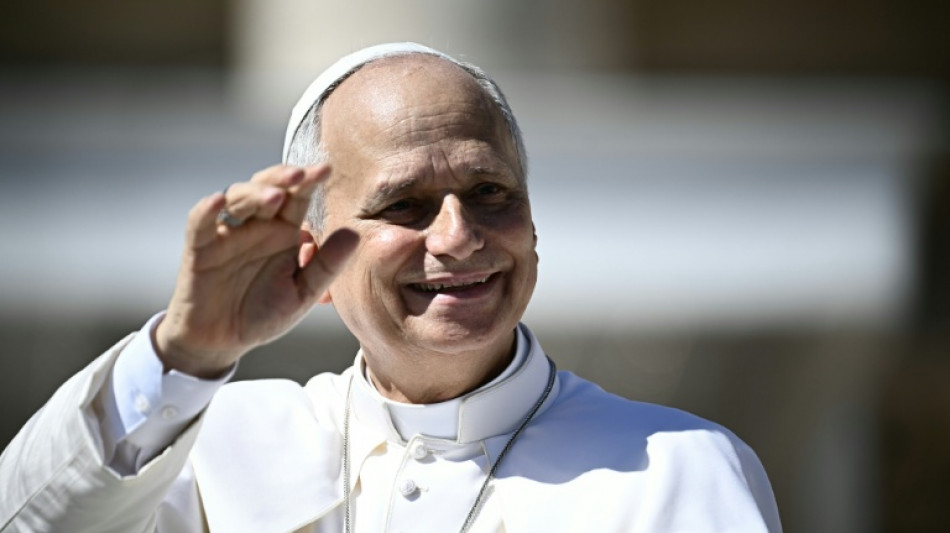
Pope Leo in France: the issues on the table / Photo: Filippo MONTEFORTE - AFP
Pope Leo XIV is set to begin an official visit to France on September 25, with several thorny issues hanging over the trip, from clerical sexual abuse to the country's new assisted dying law.
Here are some of the key issues the pontiff is expected to face while on the first official visit to France by a head of the Catholic Church in 18 years:
- Clerical abuse -
The Vatican announced in August that Pope Leo XIV will meet victims of clerical sexual abuse during his visit.
The leader of the world's 1.4 billion Catholics has promised to further efforts to reform the Church in the wake of the global sexual abuse scandal.
A 2021 inquiry found that clergy or lay members of the Church had abused about 330,000 people as minors in France, over the span of 70 years.
The Church's reputation has since been hit by further scandals, including a raft of sexual abuse accusations against charity icon Abbe Pierre and widespread physical and sexual abuse at the Notre-Dame de Betharram school in southwestern France.
The first pontiff from the United States is due to meet seven victims on September 27 in the southwestern town of Lourdes, including a former student at Betharram.
The format has been heavily criticised by victim support groups and is similar to one used in Spain in June, where Pope Leo promised the Church would make "additional efforts" to change.
- Assisted dying law -
France's parliament in June passed legislation establishing a right to assisted dying for some adults suffering from an incurable condition.
The move drew strong criticism from the Catholic Church in France, which denounced the bill as a serious "rupture".
Cardinal Jean-Marc Aveline, head of the French bishops' conference, said on Tuesday that "the defence of the dignity of human life is at the heart of the Pope's message".
"How will he convey this in France? We shall see," he added.
Martin Dumont, the secretary-general of a religion research institute in France, said it was possible Pope Leo would raise the subject.
"But I would be very surprised if he took a confrontational stance," Dumont said, suggesting the pope could instead highlight the need to care for the elderly and vulnerable.
- Presidential election -
France is just seven months away from the first round of its presidential election, making Pope Leo's visit unusual as pontiffs rarely travel to a country so close to a major vote.
The trip comes as far-right leader Marine Le Pen's anti-immigration National Rally party views next year's contest, when President Emmanuel Macron steps down, as its best chance yet to take power.
Migration, which is set to be a hot-button issue in the election, was a key focus on Pope Leo's trip to Spain in June, where he condemned "indifference" towards migrants.
In France, he is due to visit an association providing support for migrants, a "strong signal", according to Dumont.
- Europe's role -
Pope Leo's trip will be the first papal state visit to France since Benedict XVI's in September 2008.
Coming after his visit to Spain, it highlights the pope's interest in engaging with historically Catholic but increasingly non-religious European countries that were largely overlooked by his predecessor, Francis.
Pope Leo is due to deliver several speeches, including at the UN culture agency UNESCO and in the northeastern city of Metz, near the German border.
His programme in Metz includes a meeting entitled "To the roots of Europe for peace and unity".
While he is unlikely to single out any political actors during his visit to France, his message will inevitably carry political weight, said Charles Mercier, a director at France's Ecole Pratique des Hautes Etudes.
"By choosing to defend European integration, the Pope is already giving his visit a political direction," said Mercier.
The pope also places considerable importance on multilateralism and sees Europe as a counterweight to global powers, said Francois Mabille, director of the Geopolitical Observatory on Religion.
That includes "Europe's role in relation to what he calls 'imperial logics' -- namely the United States, China and Russia," Mabille said.
M.Pellegrini--GdR