Ex-president Bush remembers 9/11 through exhibit of his art / Photo: RONALDO SCHEMIDT - AFP
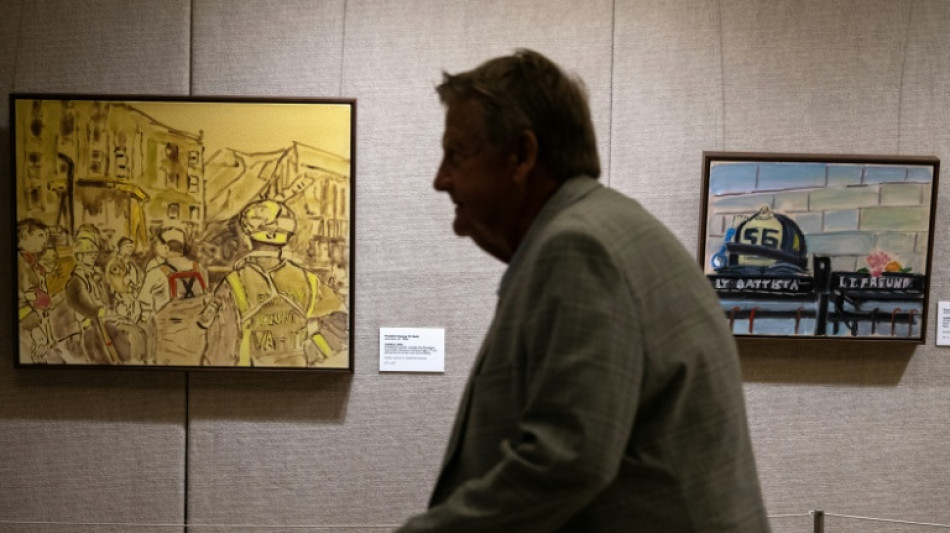
Twenty-five years after the September 11, 2001 attacks that would define his presidency, George W. Bush, now an avid painter, is displaying 16 pieces of art inspired by the tragic events.
The exhibit opens with a painting of lower Manhattan shrouded in thick gray smoke under a blue sky, the Twin Towers having both collapsed after being rammed by hijacked passenger jets.
Bush, who had taken office less than eight months earlier, has "returned to this defining moment in American history with brush and canvas, painting the symbols, the people, and the embraces that have stayed with him since," the exhibit's introduction says.
It is the latest special collection produced by the 80-year-old former president, who took up painting a few years after leaving office in 2009, with previous exhibits dedicated to portraits of veterans of his post-9/11 wars and American immigrants.
Bush himself is featured in half of the paintings, which include iconic moments, such as when he was informed by staff that a second plane has struck the World Trade Center, and more subtle scenes like him taking the hand of his father, former president George H.W. Bush.
The American flag is a recurring theme in the surprisingly colorful series, displayed at the Bush Presidential Library in Dallas, Texas.
Barely visible in the first painting depicting the attack on Manhattan, the Stars and Stripes are shown filling the entire frame in another illustrating the Pentagon -- which was struck by a third plane -- and waved by first responders in another.
"These are the moments President Bush chose to paint, because they are the moments he remembers most -- not fear, but resolve, not despair, but the instinct of ordinary Americans to come together and help one another," the exhibit says.
An immense wave of patriotism followed the 9/11 attacks, with American flags displayed throughout the nation, while Bush saw record-high approval ratings.
The commander-in-chief's poll numbers would later decline dramatically amid widespread opposition to the wars in Afghanistan and Iraq, and the economic turmoil of the global financial crisis.
"Looking at the paintings I felt like not just remembering all that happened, but remembering that unity that came," educator Farran Burnette, 40, told AFP after visiting the exhibit.
That the creator of the art was actually president during the events gives them "a different kind of weight," she said.
"To see it through his eyes in that way is really, really powerful."
For Anna Catherine Duplantis, a 17-year-old student, Bush's painting style "really connects you back" to the people and events of the time before she was even born.
"His painting is so raw, there's not all the structuredness, and it's not realism. It captures the emotions I think he feels and it can channel those emotions sometimes better than what may look like almost a movie to us," she said.
In addition to the attacks on New York and the Pentagon in Washington, a fourth hijacked plane crashed in a Pennsylvania field after passengers stormed the cockpit.
Officially 2,977 people were killed in the attacks, with thousands more deaths since linked to 9/11-related illnesses.
G.Lombardi--GdR