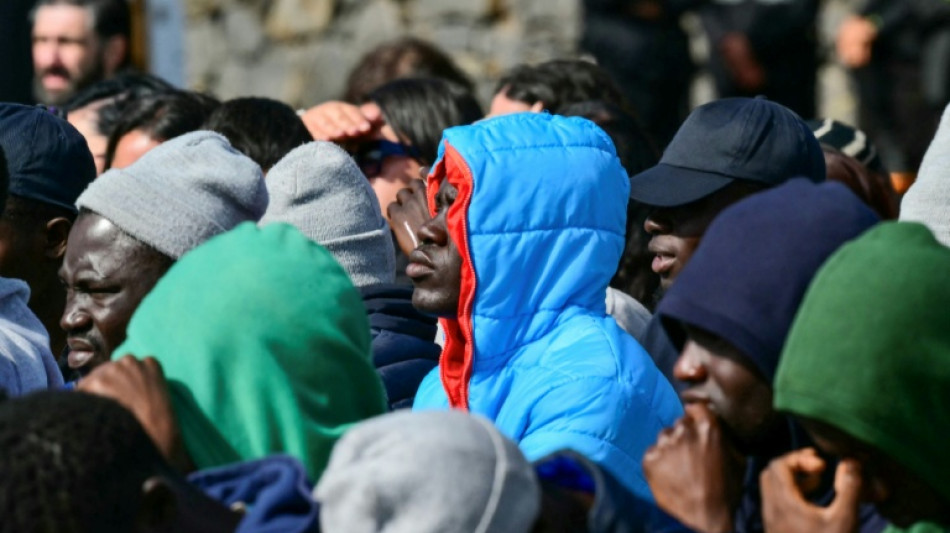
EU lawmakers approve 'return hubs' migration reform / Photo: Stefano RELLANDINI - AFP
European lawmakers gave final approval Wednesday to tougher migration rules that will grant authorities much broader detention powers and allow for the creation of deportation centres outside the bloc.
The 418 to 218 vote in Strasbourg was one of the last hurdles for a reform that has sailed through the EU's notoriously long legislative process as Brussels and member states respond to political pressure to curb migration.
It was welcomed with cheers from right and far-right parliamentarians and chants of "shame on you" from the left of the assembly, underscoring deep divisions over a text severely criticised by human rights groups.
"This regulation tells everybody that it is us and not the smugglers deciding who can stay in the European Union and who must leave," said Magnus Brunner, the EU's commissioner for migration.
The text notably enables nations to open "return hubs" outside the EU's borders, where migrants with no right to stay could be sent -- something a group of countries is raring to do.
Denmark, Austria, Greece, Germany and the Netherlands and others have already been exploring options to set hubs up.
"Our goal is to conclude the first agreements for the creation of these structures in 2026, so that they are operational from 2027," Greek Prime Minister Kyriakos Mitsotakis said on Sunday.
Until recently a fringe idea, the plan got further endorsement Tuesday, when a majority of EU nations agreed to seek to secure EU money to run such centres in a move opposed by France and Spain.
European governments have sought a tougher stance amid a souring of public opinion on migration that has fuelled far-right electoral gains across the continent.
With migrant arrivals down in 2025, the focus in Brussels has turned to improving the repatriation system, which currently sees less than 30 percent of people ordered to leave actually returned to their country of origin.
Right-wing French EU lawmaker Francois-Xavier Bellamy called the vote a "historic step for Europe and proof that change is possible," adding "we are not condemned to powerlessness."
- 'Dark chapter' -
Besides return hubs, the new measures establish a strict obligation for migrants subject to expulsion to leave and cooperate with authorities to that end.
Those who do not, or who pose a security risk or are thought to be at risk of absconding, can be detained for up to two years.
Such provisions have sparked an outcry from human rights groups and left-wing politicians.
Maria Nyman of Catholic humanitarian aid group Caritas said the changes risk "stigmatising and criminalising migrants, fuelling polarisation at a time when our societies urgently need greater cohesion."
Under the new rules authorities would be allowed to search third-country nationals, their homes or other "relevant premises" and seize personal belongings, in their push to ensure the return of irregular migrants.
Alessandro Zan of the centre-left S&D group called the reform "a dark chapter for Europe".
"It paves the way for forced deportations, increasingly invasive Trump-era ICE-style checks, and the normalisation of detention even for people who committed no crime," he said, referring to the heavy-handed practices used by Immigration and Customs Enforcement in the United States under President Donald Trump.
Proponents say return hubs -- which would serve either as the final destination or as transfer centres for those expelled -- could facilitate repatriations and act as a deterrent for would-be irregular migrants.
But critics question their effectiveness, pointing to the hurdles faced by similar projects, and compare them to "legal black holes" that could see migrants stranded in limbo with little oversight.
Britain abandoned a scheme to deport undocumented migrants to Rwanda, while Italian-run facilities to process migrants in Albania have faced legal challenges and a slow uptake.
"EU member states will be able to deport migrants and asylum seekers to so-called 'return hubs' that may effectively serve as offshore detention centres and have reportedly been discussed with rights-abusing countries like Rwanda or Uzbekistan," said Iskra Kirova of Human Rights Watch.
The law now needs a formal green light from member states -- which have already provisionally endorsed it -- to come into force.
Most new measures will apply immediately after that and some provisions 12 months later.
L.Ferrari--GdR