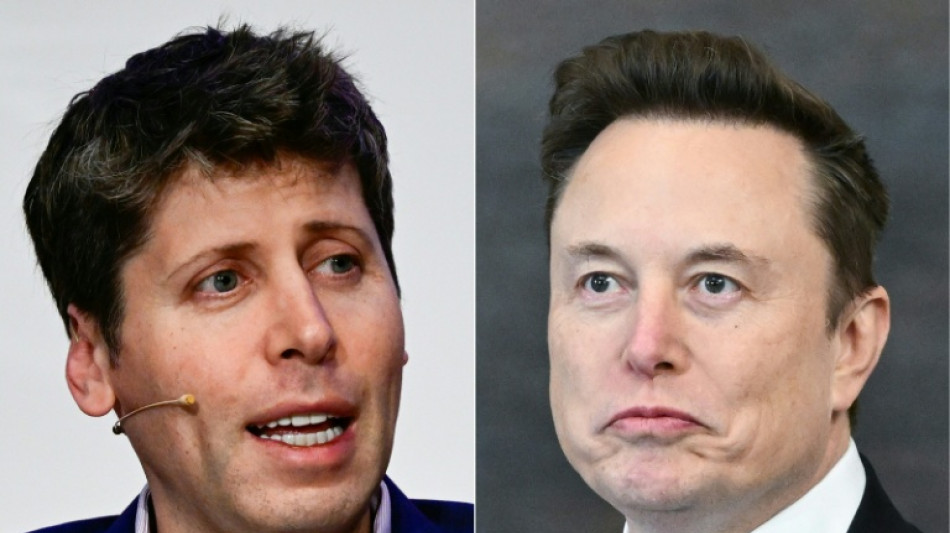
Musk loses blockbuster OpenAI suit as jury says too late / Photo: John MACDOUGALL, SAUL LOEB - AFP/File
A federal jury ruled Monday that Elon Musk waited too long to sue OpenAI and its co-founders, delivering a decisive victory to OpenAI CEO Sam Altman and ending one of Silicon Valley's most closely watched courtroom battles.
The jury in Oakland federal court found that Musk's claims against Altman, OpenAI President Greg Brockman, The OpenAI Foundation and Microsoft were barred by relevant statutes of limitations, rejecting the billionaire's core arguments.
Judge Yvonne Gonzalez Rogers, who had asked the jury to advise her on the matter, accepted and confirmed the verdict.
The three-week trial saw a parade of tech titans take the stand, with Musk arguing that OpenAI's pivot to a profit-driven business betrayed its original nonprofit mandate.
The outcome spares OpenAI from a potentially existential legal threat.
Had Musk prevailed, he was seeking to force the company to revert to its nonprofit structure -- a move that would have derailed its planned IPO and unwound ties to major investors including Microsoft, Amazon and SoftBank, who have poured billions into the company amid the global AI race.
Musk, the world's richest person, had sued OpenAI over its transformation from a scrappy nonprofit into the $850 billion juggernaut behind ChatGPT, claiming Altman and Brockman improperly used a $38 million donation he had intended to sustain OpenAI as a research lab devoted to developing AI for the benefit of humanity.
The jury first had to resolve a threshold issue: whether Musk, who filed suit in 2024 -- four years after his last contribution -- had done so within the statutory time limit.
It found he had not, ending the case before jurors could weigh the underlying merits.
The judge had ruled ahead of deliberations that the jury's verdict on the statute of limitations would be advisory, but said she would likely follow its recommendation.
Had the case proceeded, jurors -- and ultimately the judge -- would have determined whether OpenAI's co-founders misappropriated Musk's donations and broke promises to him in order to pursue a commercial path and enrich themselves.
- Dueling billionaires -
Closing arguments had centered heavily on Altman's integrity and behind-the-scenes maneuvering that rankled colleagues. Musk attorney Steven Molo attacked Altman's credibility, invoking OpenAI's founding vision.
"A non-profit devoted to the safe development of artificial intelligence, open sourced as practical, for the benefit of humanity. You know, we're supposed to buy that," Molo said Thursday.
OpenAI attorney Sarah Eddy countered with an attack on Musk himself, pointing to testimony from Shivon Zilis -- a business associate of Musk with whom he has four children -- who had served as an intermediary between the tech executives.
"Even the people who work for him, even the mother of his children, can't back his story," Eddy said.
As Judge Gonzalez Rogers noted during the trial, the case had in many ways come down to a simple question: who to believe among the bickering billionaires.
Musk left OpenAI in 2018 and has since pursued AI projects through his rocket company SpaceX, while his AI startup xAI has struggled to gain traction against OpenAI and Anthropic, another prominent California-based company.
Altman, who was fired unexpectedly by OpenAI's board in November 2023 for a lack of candor before being reinstated under pressure from employees, emerged from the trial with allegations of manipulation and a toxic work culture largely unresolved by the verdict.
Microsoft, OpenAI's largest private backer with $13 billion committed, was also spared.
Musk's accusation that the Windows-making giant was liable for aiding and abetting the alleged breach of charitable trust fell away once the underlying case was ruled invalid.
M.Pellegrini--GdR