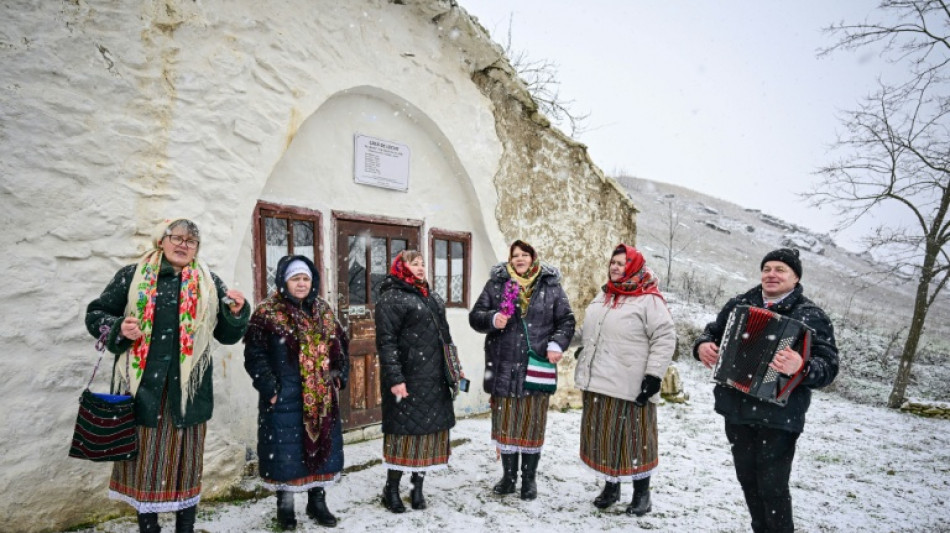
'Hobbit houses' that might just save a Moldovan village / Photo: Daniel MIHAILESCU - AFP
They call Rogojeni the "hobbit village", and its little half-buried houses, built to resist Moldova's cold winters and hot summers, do look like something from "The Lord of the Rings".
The traditional dugout houses have put the shrinking settlement on the tourist map and locals hope they may also help to save it.
"We do fear that the village could disappear, considering that there are so few people left," said mayor Ruslan Groza, with only 30 people left in a hamlet that once had a population of 200.
"My goal is to develop this locality, build roads, repair where possible the houses that can be preserved and develop tourism," he told AFP.
Rogojeni is one of the last villages that still boasts the low stone "basca" houses built into grassy hills, with their small doors forcing people to stoop down when they enter.
More and more tourists are coming after one of the dwellings was repaired and opened to visitors in 2020, said Groza.
A South Korean student was visiting when AFP went to the village two hours north of the capital Chisinau earlier this month. He had even been invited to join a pig roast by locals ahead of the January 7 Christmas celebration.
Such customs are "hard to see" elsewhere, said Sangkyoung Lee, 22, who looked amazed as smoke rose from the burning hay covering the pig as snow fell all around.
Inside the house-turned-museum, pig stew, polenta with sheep cheese, pickles and red wine were served around a table in a small room with an arched entrance and blue walls decorated with traditionally handsewn carpets in lively colours.
- Exodus -
While mayor Groza, a 46-year-old history teacher, takes pride in the "immense cultural heritage" of the village, he admits most of it has been left to decay, like an old school and church of which only the outer walls remain.
With tens of thousands of Moldovans emigrating every year mostly to EU countries for a better life, many villages have become ghost towns.
Since 2014 Moldovan villages have lost almost half a million inhabitants, according to a 2024 census, with a million Moldovans estimated to be living abroad.
But the mayor's wife, Mariana Groza, 45, is optimistic, insisting that villages will "revive along with tradition".
A literature and French teacher, she started an embroidery and traditional costumes workshop, posting her work on TikTok.
"I have loved this craft since childhood. Not a day goes by without me sewing a cross-stitch or crocheting something. If I don't, the day passes in vain for me," she said.
"We must promote traditions."
- Singing and dancing -
Together with other women from the village, including two grandmothers over 80, she sang traditional carols in front of the museum, ringing a bell while a man played the accordion, as part of the pre-Christmas celebration.
On one of the more joyous songs, the two grandmothers hugged each other and started dancing and cheering.
"When I got married here, there were lots of people, there were children, the village was beautiful," Maria Ardeleanu, one of the two women, told AFP.
"Now there's no one left. Just us, a bunch of old women," she added, saying she enjoys talking to tourists who want to know what it's like to live in the "basca".
"I tell them during the summer it is cool, it's nice inside. And in winter it is warm and I don't go out much," she said.
When the carols ended, the singers threw wheat grains to the listeners to wish them prosperity.
Ardeleanu's dance partner counted the ones she caught.
"Eight," she said cheerfully. "Tradition says that's how many years I've still got to live."
G.Brambilla--GdR