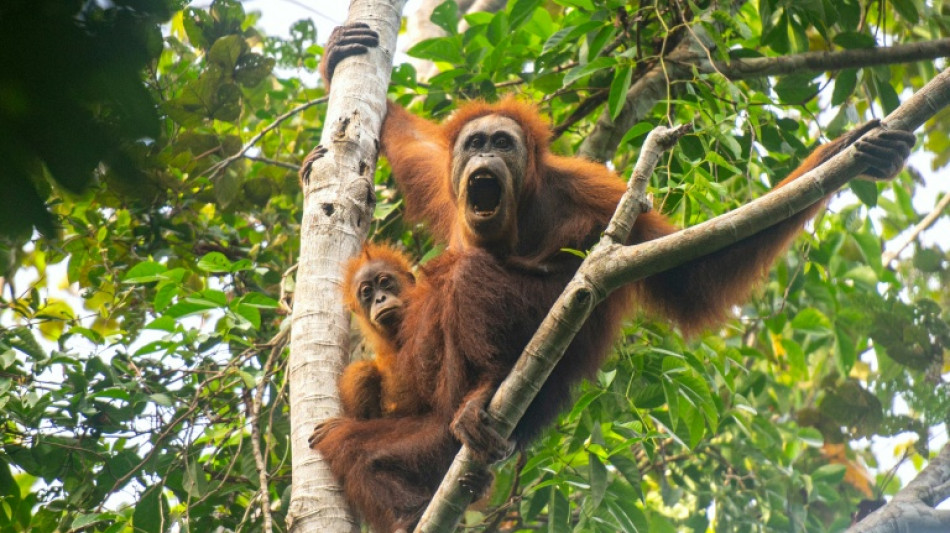
Climate change-fuelled storm decimated world's rarest great ape: study / Photo: Handout - Orangutan Information Centre/AFP
Climate change-fuelled landslides wiped out nearly one in ten of the world's rarest great ape species on Indonesia's Sumatra island, scientists said Wednesday.
A single weather event last November pushed the Tapanuli orangutan -- of which there are fewer than 800 left in the wild -- even closer to extinction, according to a study published in the science journal Current Biology.
An estimated 58 Tapanuli orangutans died as a result of mudslides triggered by heavy rains during Cyclone Senyar -- about 11 percent of the total living in the region, or seven percent of the estimated overall wild population.
The flooding killed more than 1,000 people.
Only scientifically classified as a species in 2017, Tpanulis are incredibly rare, confined to a small range in Sumatra.
"This level of loss is substantial for a species with such a small total population," said Erik Meijaard, chief scientist at Borneo Futures, a conservation initiative.
The floods also wiped out sources of Tapanuli food and shelter.
Scientists analyzed satellite evidence of landslide scars in the Batang Toru Ecosystem -- home to the largest remaining population of the apes.
They found that about 8,300 hectares of forest -- more than 11 percent of the area -- were affected.
The lost forest area was overlaid with orangutan density maps to come up with an estimate of population loss.
"The loss of an estimated 58 Tapanuli orangutans to a single climate-induced landslide event is a devastating demographic shock to the world's rarest great ape," said researcher Jatna Supriatna of Indonesia University.
Environmentalists have long campaigned against industrial activity in Batang Toru, particularly a hydroelectric dam and gold mine.
The highland homes inhabited by Tapanulis are not their preferred habitat, but it is where remaining orangutans have been pushed by human development elsewhere.
"To prevent the first modern extinction of a great ape species, Indonesia must permanently protect the Batang Toru ecosystem," Jatna said.
"But our international partners must also meet their global commitments by providing immediate biodiversity-recovery financing."
Sumatra lost 4.4 million hectares of forest -- an area larger than Switzerland -- between 2001 and 2024, making hilly landscapes more vulnerable to landslides, the conservation group Mighty Earth said in February.
P.Vincenze--GdR