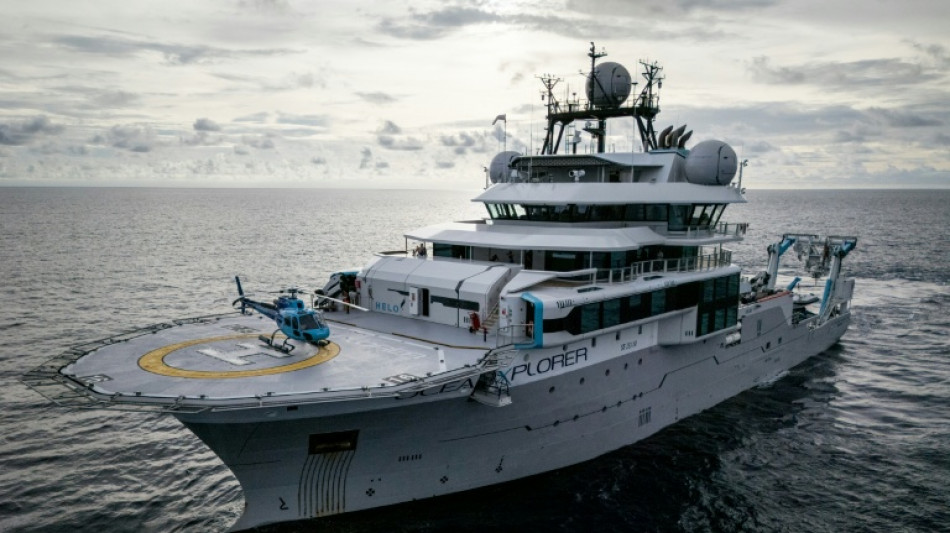
OceanXplorer: a 'one-stop shop' for marine research / Photo: YASUYOSHI CHIBA - AFP
This month, AFP reported from OceanXplorer, a high-tech marine research vessel owned by billionaire-backed non-profit OceanX, as it studied seamounts off Indonesia.
The ship pairs advanced scientific research with high-end media content to make marine biology and conservation accessible.
- A one-stop shop -
A former oil exploration ship, OceanXplorer belongs to OceanX, which was founded by wealthy investor Ray Dalio and his son Mark.
It was retrofitted with everything from laboratories for genetic sequencing to helicopters for aerial surveys.
It is a "researcher's dream", according to Sekar Mira, a cetacean specialist on board from Indonesia's National Research and Innovation Agency (BRIN).
There are two submersibles -- one with 8K cameras for ultra-high-definition media content, and a science vessel equipped to collect samples from 1,000 metres under the sea
For deeper exploration, there is a remotely-operated vehicle capable of divingto 6,000 metres, and the ship also has mapping radar, bongo nets for capturing plankton and a CTD (conductivity, temperature, depth) instrument.
"It is essentially a one-stop shop for ocean science," said mission lead Andrew Craig. "There's nothing else like it in the world."
- Rotating science teams -
OceanXplorer has been at sea almost continuously since 2021. AFP joined as it surveyed biodiversity on a deep-sea mountain chain off Sulawesi island.
Each mission brings in local government and research institutions, and a new team of local scientists.
This time they include "megafauna" specialist Sekar, researching whales and dolphins, and genetics and molecular biotechnology expert Husna Nugrahapraja, who is "bioprospecting" compounds for new medicines.
"We will extract the DNA and then we want to do what is called metagenomic sequencing... and then we try to mine the data," said Husna, an assistant professor at Institut Teknologi Bandung.
Being able to do all that on board is "really impressive," he added.
BRIN marine biologist Nur Fitriah Afianti scrutinises plastic waste from thousands of metres below the surface for helpful microbes.
"Maybe the microbes can digest the plastic waste. Maybe, I hope," she said.
- eDNA work -
The visiting scientists are supported by OceanX experts like Larissa Fruehe, a specialist in environmental DNA (eDNA).
She calls it "the coolest thing ever" because of its potential to detect species long after they have left an environment.
"Every organism is releasing their DNA into their respective environment" in the form of feathers, hair, scales, mucus or even faeces, Fruehe said.
Filtering those traces from soil, air or water paints a picture of what has passed through.
OceanXplorer can "run a whole eDNA workflow in its entirety, from sampling to actual bioinformatic analysis", Fruehe said.
Among those working with eDNA on board is coelacanth specialist Alex Masengi.
He is hunting for signs of the ancient fish at 900 metres, far below its known range.
- Hollywood touches -
OceanX brought in Hollywood designers to make the ship telegenic, with a futuristic "mission control" and customisable lighting for optimal filming conditions.
It is a deliberate attempt to make marine science compelling for a mass audience, including OceanX's four million TikTok followers.
OceanX does not advertise the ship's cost or its operating budget, but its parent body's 2024 US tax filing reported over $44 million in expenses.
Much of that comes from the Dalio family, though outside grants help fund missions too.
Privately funded science can be controversial, but OceanX notes that its research is all publicly accessible, and it partners with government and institutions often unable to expend their limited resources on marine science.
- Research and filming firsts -
OceanXplorer trips have generated dozens of scientific papers, on everything from deep-sea shark behaviour in the Red Sea to whales and dolphins off Indonesia.
Its cameras have filmed rare footage of groups of coelacanths near Indonesia, and observed newly discovered brine pools in the Red Sea.
In between missions, students are invited on board as part of OceanX's education mission.
"It's about conservation, it's about education and it's about exploration," said Craig.
"They want to go to new places, they want to explore, and they want to bring back that knowledge and make it available to the public."
S.Esposito--GdR