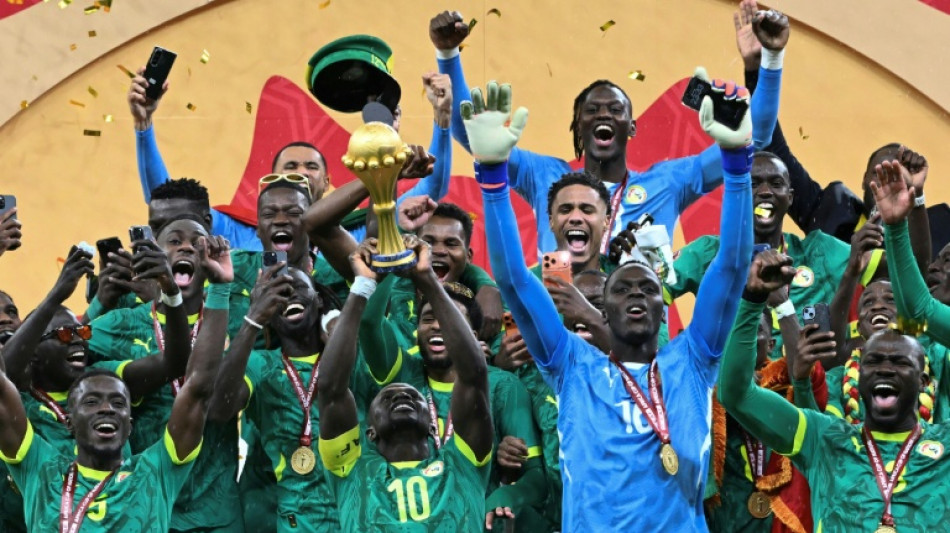
Senegal demands 'corruption' probe over AFCON decision as Morocco defend appeal / Photo: SEBASTIEN BOZON - AFP
Senegal's government said on Wednesday it wanted an "independent international investigation" into corruption after its national team were sensationally stripped of the Africa Cup of Nations title with the Confederation of African Football (CAF) declaring Morocco champions, two months after their chaotic final.
Several Senegalese players controversially walked off the pitch in Rabat during the final on January 18 in protest when the hosts were awarded a penalty late in second-half stoppage time.
After Senegal's players eventually returned having been coaxed back onto the pitch by captain Sadio Mane, Morocco missed the penalty and Pape Gueye went on to score the goal in extra time that gave his team a 1-0 victory.
After a Morocco appeal asked the governing body to study competition rules, CAF recorded a 3-0 victory in favour of the tournament hosts on Tuesday, sparking uproar in Dakar.
"By calling into question a result achieved at the end of a match that was properly played and won in accordance with the rules of the game, the CAF seriously undermines its own credibility", Senegalese government spokeswoman Marie Rose Khady Fatou Faye said in a statement.
"Senegal unequivocally rejects this unjustified attempt at dispossession" she added, while calling for "an independent international investigation into suspected corruption within the CAF's governing bodies".
The CAF Appeals Committee justified its decision by applying Articles 82 and 84 of the AFCON Regulations, which state that if a team "refuses to play or leaves the ground before the regular end of the match without the authorisation of the referee, it shall be considered (loser) and shall be eliminated for good from the current competition".
The articles add the team contravening the regulations "will lose its match by 3-0".
The Royal Moroccan Football Federation (FRMF) said late Tuesday that its appeal "was never intended to contest the sporting performance of the teams participating in this competition, but solely to request the application of the competition regulations".
In a further statement on Wednesday it added: "This decision helps clarify the rules applicable in similar situations and contributes to the coherence and credibility of international competitions, in particular when it comes to African football."
Senegal's football authorities said they will appeal "as soon as possible" to the Court of Arbitration for Sport.
- Chaotic scenes -
Minutes before the end of the match, some Senegalese supporters attempted a pitch invasion, while Senegal's players halted the game for nearly 20 minutes to protest the penalty awarded to Morocco.
The controversial spot-kick was given by Congolese referee Jean-Jacques Ndala right at the end of the allotted eight added minutes in normal time following a VAR check for a challenge on Brahim Diaz by El Hadji Malick Diouf.
The game was goalless at the time and Diaz could have won the trophy for Morocco with the spot-kick, eventually taken in the 24th minute of added time at the end of normal time.
But Senegal goalkeeper Edouard Mendy easily saved the weak attempted 'Panenka' chip by the Real Madrid winger, who was clearly distracted by the long delay that followed the penalty award.
The game went to extra time before Gueye's brilliant 94th-minute winner.
Several Senegal players posted on social media after Tuesday's announcement.
Lyon defender Moussa Niakhate posted a picture of himself lifting the Africa Cup of Nations trophy with a message saying "they're mad" apparently in reference to CAF.
In the immediate aftermath of the final, FIFA president Gianni Infantino had condemned "some Senegal players" for the "unacceptable scenes".
"It is unacceptable to leave the field of play in this manner, and equally, violence cannot be tolerated in our sport, it is simply not right," Infantino, who attended the match, said.
The appeal trial of 18 Senegalese supporters, imprisoned since the final and sentenced to prison terms ranging from three months to one year has been postponed until March 30.
G.Pozzi--GdR