Lorne Doerkson Sworn In as B.C. Premier, Urges Youth to Stay
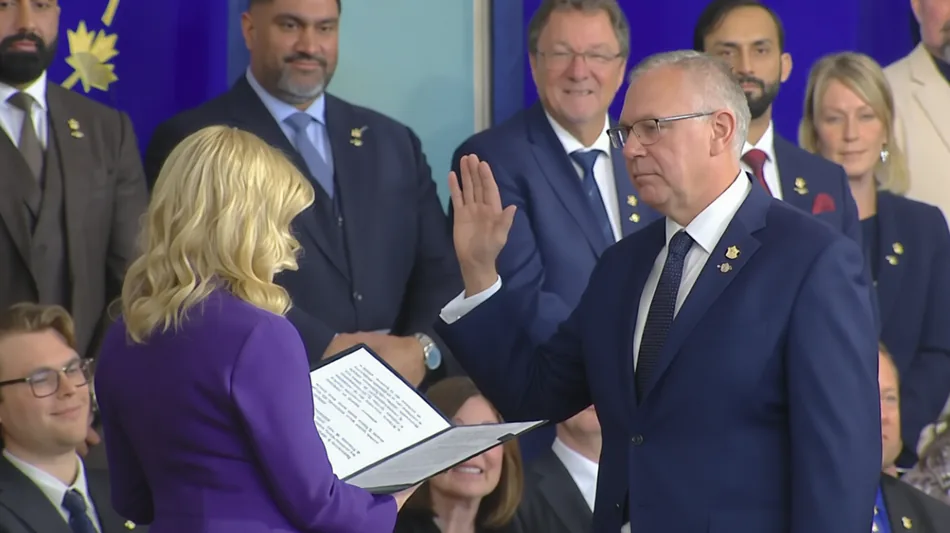
Lorne Doerkson was sworn in as British Columbia’s 38th premier on November 20, 2026, leading a new majority Conservative government. In his inaugural address at Government House in Victoria, Doerkson outlined a platform focused on economic growth and affordability, issuing a direct appeal to young British Columbians to stay in the province rather than seeking opportunities elsewhere.
Lorne Doerkson was formally installed as British Columbia’s 38th premier on November 20, 2026, following the swearing-in of his new majority Conservative government at Government House in Victoria. In his first public address as head of the provincial government, Doerkson outlined a mandate centered on economic revitalization and affordability, while issuing an urgent appeal to young British Columbians to remain in the province despite current challenges.
The ceremony was presided over by Lieutenant Governor Wendy Cocchia, who administered the oath of office to Doerkson and his 24 cabinet colleagues. The new Executive Council comprises the premier, 18 ministers, and six ministers of state. Key appointments include Claire Rattée, MLA for Skeena, who serves as deputy premier and minister of social development. Peter Milobar, MLA for Kamloops Centre, has taken on the role of finance minister, while Ryan Peterson, MLA for Coquitlam-Burke Mountain, is appointed as health minister. Caroline Elliott, MLA for West Vancouver-Capilano, assumes the position of attorney general.
Additional cabinet roles include Trevor Halford, MLA for Surrey-White Rock, as transportation and infrastructure minister; Cathie Ounsted, who oversees local government, housing, sport, and culture; and Zeeshan Wahla, serving as minister of state for housing. Two parliamentary secretaries have been assigned specific regional responsibilities: Harj Dhaliwal, MLA for Surrey-Newton, will cover TransLink, and Megan Knight, MLA for Surrey South, will focus on the Metro Vancouver Regional District.
During his address, Doerkson emphasized the gravity of the responsibility placed upon his government by voters. He acknowledged the trust bestowed upon him and his team, stating that they accept this role with humility and a deep sense of purpose. He pledged to work tirelessly for every British Columbian and to honor the mandate by delivering on commitments.
"Our goal is to make British Columbia the most prosperous province in Canada where our children don’t have to leave to find opportunity because they can build a good life and a family right here in this beautiful province," Doerkson said. "A strong economy matters folks. It matters to all of us."
The premier highlighted that economic strength is not an abstract concept but a prerequisite for funding essential public services. He argued that a robust economy generates the revenue necessary to support healthcare, social services, and other critical infrastructure. Without financial stability, he noted, the government cannot provide timely healthcare, treatment for addiction, dignity for seniors, affordable childcare, or adequate support for families with children on the autism spectrum.
Doerkson also addressed the demographic shift affecting the province, noting that too many young people are leaving to find opportunity elsewhere. He made a direct plea to this demographic, as well as to business owners who have considered relocating.
"And to every one of our youth, I am telling you to stay. I’m begging you to stay in British Columbia," Doerkson said. "We want those business owners that have contemplated going elsewhere to stay."
He described his administration’s approach as one of accountability and transparency. He promised that the government would explain its decisions, take responsibility for outcomes, and admit when errors occur. He invited opposition members of the Legislative Assembly to hold the government accountable, framing their role as essential to democratic governance.
"To the members who sit across from us, you have an incredibly important role, and I will expect it of you to keep our government to account, hold us to account for the things that we do and the work that we do," he said. "We will have our disagreements for certain... but we also share something that is very important and it’s one thing not to be forgotten: a responsibility to the people of British Columbia and a desire to leave this province better than we found it."
Doerkson extended an invitation to mayors and city councillors, both those present in Victoria and those across the province, to serve as partners in governance. He acknowledged that local officials know their communities better than anyone in the provincial government and vowed to listen to them closely.
He also addressed relations with First Nations, promising to build relationships grounded in respect, dignity, and trust. He committed to engaging in honest conversations and genuine partnership with every First Nation in British Columbia.
The premier reflected on his personal journey into politics, drawing lessons from his first election in 2020 during the early stages of the COVID-19 pandemic. He recalled receiving a key to the legislature building and phoning his late father, who had advised him to be honest and deliver on promises made to constituents.
"Honesty is the foundation of trust. And without trust, you cannot lead," Doerkson said. "And I’ve learned that the way you carry yourself, frankly, is very important, and it says more about your leadership than words ever could."
He acknowledged the current difficulties facing residents, including rising costs of everyday life and strained healthcare systems. He also touched on issues of community safety, promising to support law enforcement, stand with victims, and deal seriously with violent and repeat offenders.
Doerkson highlighted the need for recovery support in communities affected by recent natural disasters, specifically mentioning Clinton, Cache Creek, Merritt, Pemberton, and Lytton. He emphasized a vision of unity across the province, rejecting narratives that pit rural against urban or north against south.
"We come from different places, of course. We worship differently, we vote differently, and we see the world differently, but we are neighbours first and British Columbians together," he said. "We can disagree passionately... But we are going to treat each other with respect and decency and dignity, and that starts with me."
He referenced a recent incident involving an attack on a mosque, stating unequivocally that there is no space for hate in British Columbia. He shared a personal anecdote about reaching out to Minister Zeeshan Wahla to help paint over graffiti, noting that while the city had already responded, his gesture was symbolic of the government’s stance.
Doerkson outlined his plan to travel extensively across the province, visiting diners and meeting residents to hear their concerns directly. He described the province’s potential as vast, citing its natural resources, talented workforce, and hard-working communities.
"Our job is to unlock what this province can become, and that is the envy of the world," he said. "A mill in the north. A manufacturer in the interior. A farmer in the Fraser Valley. A port on the coast. They might be hundreds of kilometres apart, but they are all part of the same economy and the same story."
He concluded by reiterating that success in one region should benefit the entire province. He called for clearing obstacles to allow British Columbians to dream big, take risks, and build a better future for the next generation.
"This is a province that I see ahead of us — not north versus south, not rural versus urban. But every single corner of British Columbia working together, each contributing something, and each contributing something different, but each sharing in our success," Doerkson said. "And that is how we will build a more prosperous province and a better future for the people that call this beautiful place home."
The swearing-in ceremony marked the official transition of power, with Doerkson assuming the role of premier effective immediately. His government now faces the task of implementing its platform in a province grappling with economic pressures and social challenges.
G.Vitali--GdR