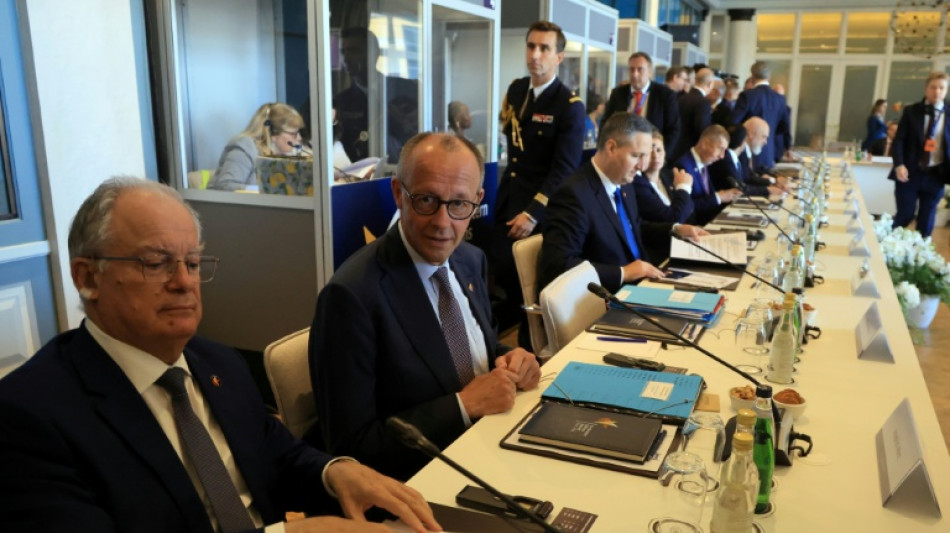
Balkan integration in the spotlight at EU summit / Photo: Ludovic MARIN - AFP
European leaders gathered in Montenegro on Friday with a renewed focus on "gradual integration" for six Western Balkan nations vying to join the bloc.
"We need to make the enlargement process faster and more credible," European Commission President Ursula von der Leyen said on her arrival at the summit in the small town of Tivat, best known for its superyacht-lined port.
Montenegrin President Jakov Milatovic welcomed several European leaders, including France's Emmanuel Macron and Germany's Friedrich Merz, on Friday morning. His Balkan nation is among those bidding to become an EU member state.
- Gradual integration -
After decades of back-and-forth over the future membership of the six Western Balkan nations, Russia's invasion of Ukraine in 2022 reinvigorated Brussels's interest in expanding the bloc.
Since the war began, both Ukraine and Moldova have joined the queue of countries seeking accession alongside Balkan hopefuls: Albania, Bosnia, Kosovo, North Macedonia, Montenegro and Serbia.
France and Germany seized on the meeting to push the idea of "gradual integration" into the bloc that currently has 27 member nations.
"Together with Germany we have proposed a strengthened gradual integration process," President Emmanuel Macron told media as he arrived at the summit.
He said that the proposal could mean that a country that aligns itself with the EU on certain criteria would be allowed to join certain bloc formats, for example, attending European Council meetings.
"The fact that we have not welcomed any new members for 13 years shows that the shortcomings also lie on the side of the European Union, and that is what we want to overcome today," German Chancellor Friedrich Merz said.
The idea of "halfway" integration is increasingly being discussed. Serbian President Aleksandar Vucic and Albanian Prime Minister Edi Rama recently argued in a joint op-ed for faster integration in exchange for new members having no veto rights.
- 28 by 2028? -
Enlargement "is very important from a geopolitical point of view, because this region is also where Europe's independence is at stake in terms of energy, security and migration routes," Macron said.
But with some countries remaining candidates for more than 15 years, support for joining the bloc has taken a hit in certain Balkan nations.
Serbia, which maintains close ties with Moscow, is among the most eurosceptic countries in the region, and public support for membership is below 50 percent.
Although Brussels has long said all the remaining Balkan nations would be accepted together, Montenegro and Albania are increasingly emerging as the frontrunners to join the bloc first, pulling ahead of countries like Serbia and Bosnia which lag on the required reforms.
Montenegro's progress has led Marta Kos to flag the possibility of concluding the technical negotiations by the end of the year, which would open the way to membership by the end of 2028, 20 years after it submitted its application.
S.Rinaldi--GdR