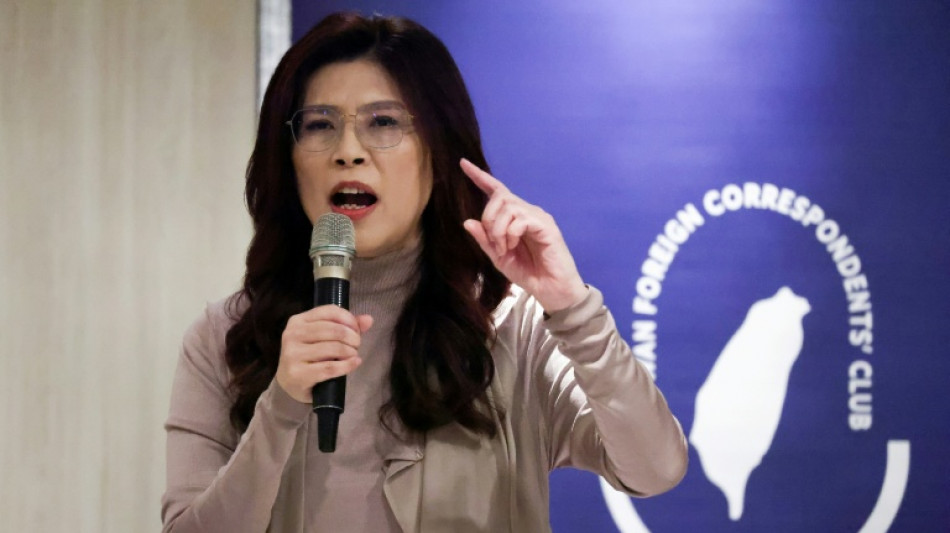
Taiwan opposition leader to make 'peace' visit to China, first in 10 years / Photo: I-Hwa Cheng - AFP
Taiwan's main opposition leader will make a rare trip to China on Tuesday, weeks before US President Donald Trump, with Beijing expected to use the visit to increase its influence over the democratic island.
Cheng Li-wun, who will become the first sitting chairperson of the Kuomintang (KMT) to travel to China in a decade, said she wants to meet Chinese President Xi Jinping to build cross-strait "peace".
Taiwanese officials and experts, however, say Xi sees an opportunity to reinforce Cheng's standing in the KMT and stymie further US weapons sales to Taiwan.
The KMT has long advocated for closer relations with China, which claims Taiwan is part of its territory and has threated to use force to seize it.
But Cheng, whose unexpected rise to the top of the KMT drew congratulations from Xi in October, has been accused by critics, including inside the party, of being too pro-China.
Cheng's visit comes as the United States -- Taiwan's most important security backer -- intensifies pressure on Taiwanese opposition lawmakers to approve a proposal for defence purchases, including billions of dollars worth of US weapons, to deter a potential Chinese attack.
The KMT leader, who has railed against the government's NT$1.25 trillion ($39 billion) plan, faces deepening divisions inside her party over how to counter China's military threats.
Cheng backed a KMT proposal to allocate NT$380 billion for US weapons with the option for more acquisitions, but more moderate senior figures in the party are pushing for a much higher budget.
Beijing sees "a need to rescue Cheng Li-wun" from a "power crisis", Albert Tzeng, a former KMT adviser, told AFP.
Xi's endorsement of Cheng will make her critics wary of attacking her, Tzeng said.
And Xi, who has tied taking Taiwan to his vision of the "great rejuvenation of the Chinese nation", can show Beijing is "not losing Taiwan altogether to the United States", he said.
Taiwan's top China policy body warned Beijing had "summoned" Cheng for the purpose of cutting off "Taiwan's military purchases from the US and cooperation with other countries".
"Beijing's intention, in short, is to internalise the cross-strait issue, treating it as a domestic matter for China, with foreign intervention prohibited," Mainland Affairs Council spokesman Liang Wen-chieh said Thursday.
Cheng hit back, saying: "This trip is entirely for cross-strait peace and stability, so it has nothing to do with arms procurement or other issues."
- Public views mixed -
While KMT party members regularly fly to China for exchanges with officials, its last leader to visit was Hung Hsiu-chu in 2016.
China severed high-level contact with Taiwan that year after Tsai Ing-wen of the Democratic Progressive Party won the presidency and rejected Beijing's claims on the island.
Cross-strait relations have worsened since then as China ramped up military pressure with near daily deployments of fighter jets and warships near Taiwan and regular large-scale military drills.
Xi's invitation to Cheng shows Beijing has identified her "as part of the force who support unification," said Tzeng Wei-feng, from National Chengchi University's Institute of International Relations.
Taiwanese people have mixed views about Cheng's trip.
"If you're talking with other democratic countries, I think agreements might still have some effect," 47-year-old Mac Peng told AFP.
"But if you're negotiating with the Chinese Communist Party, that's just suicidal."
Glen Ger, 60, was more optimistic, saying the KMT would "let everyone know that public opinion isn't completely one-sided, so they can understand that people want peace".
- US arms sales -
The trip enables the KMT to tell voters that they "are the ones who can actually lead Taiwan towards the direction of peace and stability", said Lev Nachman, a political science professor at National Taiwan University.
A friendly meeting with Cheng could help Xi "undermine the argument for US-Taiwan defence cooperation" ahead of the summit with Trump in May, said Wen-Ti Sung, a nonresident fellow at the Atlantic Council's Global China Hub.
While the United States has long been ambiguous about its willingness to defend Taiwan, Washington remains Taipei's biggest arms supplier, which angers Beijing.
The United States approved the sale of $11 billion worth of arms to Taiwan in December. More deals are in the pipeline, but there have been doubts about whether they would proceed after Xi warned Trump against sending weapons to Taiwan.
Cheng has insisted she supports Taiwan having a strong defence, but said the island does not have to choose between Beijing and Washington.
James Yifan Chen, a political analyst at Tamkang University, said Cheng will have to "work harder to assure Washington that she is also a partner of the US".
A.Conti--GdR