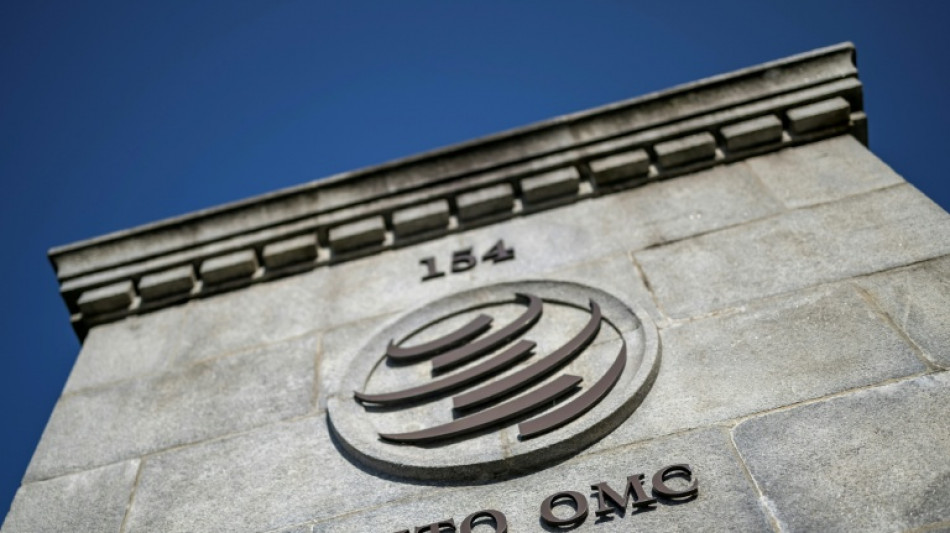
Middle East war weighs on global trade outlook: WTO / Photo: Fabrice COFFRINI - AFP
The Middle East war could weigh heavily on already slowing global trade, potentially threatening global food security, the World Trade Organization warned Thursday.
If energy prices remain high, the WTO forecasts that merchandise trade volumes could grow just 1.4 percent this year, compared to 4.6 percent in 2025.
The WTO's annual global trade outlook was released nearly three weeks into an escalating war in the Middle East that is already causing soaring energy prices and reviving fears that a major economic crisis is looming.
"Sustained increases in energy prices could increase risks for global trade, with potential spillovers for food security and cost pressures on consumers and businesses," warned WTO chief Ngozi Okonjo-Iweala.
She told reporters in Geneva that among other things the war "threatens global food security", appealing for supply chains to remain open.
Since US-Israeli forces launched the war against Iran on February 28, Tehran has responded with attacks throughout the Middle East and threats that have nearly halted shipping in the Strait of Hormuz, through which one-fifth of global oil supplies normally pass.
And the conflict appears to be escalating, with massive attacks targeting oil and gas production, storage and transportation infrastructure across the region.
Since the start of the war, WTO economists have been working to revise their annual forecasts.
Given the high degree of uncertainty around the impact of the war and its duration, the organisation on Thursday presented two possible scenarios for how global trade will evolve this year.
- Trade normalisation -
In the first scenario, which excludes possible energy price shocks, growth in global merchandise trade volumes is expected to slow this year to 1.9 percent from 4.6 percent last year.
That scenario assumes a slight dip in global gross domestic product (GDP) growth, from 2.9 percent in 2025 to 2.8 percent this year and in 2027.
According to the WTO, that scenario would see merchandise trade "normalise" this year, regardless of the war in the Middle East, after stronger-than-expected growth in 2025 driven especially by a surge in artificial intelligence-related products.
Trade last year was also boosted by among other things "the front-loading of imports in North America ahead of the expected imposition of 'reciprocal' tariffs by the United States", the WTO said in its report.
In the first scenario, global merchandise trade volumes are projected to grow by 2.6 percent in 2027.
The volume of trade in services would meanwhile swell by 4.8 percent this year and 5.1 percent next year, WTO economists projected.
"The outlook reflects the resilience of global trade, buoyed by trade in high technology products and digitally delivered services, adaptations in supply chains and the avoidance of tit-for-tat retaliation on tariffs," Okonjo-Iweala said.
- 'Economic burden' -
However, she cautioned, "this baseline forecast is under pressure from the conflict in the Middle East".
Among other things, the conflict "threatens critical global transport corridors, with traffic through the Strait of Hormuz collapsing from 138 commercial vessels per day to almost zero", the WTO said.
It cautioned that if crude oil and liquefied natural gas prices were to remain high throughout the year, that "would shave 0.3 percentage points off the GDP forecast for 2026".
That, in turn, would reduce the trade forecast for this year by 0.5 percentage points, it said.
WTO chief economist Robert Staiger told reporters that the second scenario was based on an average annual oil price of "around $90 a barrel".
That is well below the current price, with Brent North Sea crude trading at over $112 per barrel on Thursday afternoon.
In the second scenario, "merchandise trade volumes would grow by just 1.4 percent", the WTO said, adding that services trade would also grow at a slower rate of 4.1 percent this year.
Net fuel-importing regions like Asia and Europe would experience the sharpest declines in merchandise import growth in the second scenario, the trade body said.
Okonjo-Iweala stressed that countries "can help cushion the impact and ease the economic burden on people worldwide by maintaining predictable trade policies and strengthening supply chain resilience".
M.Marini--GdR