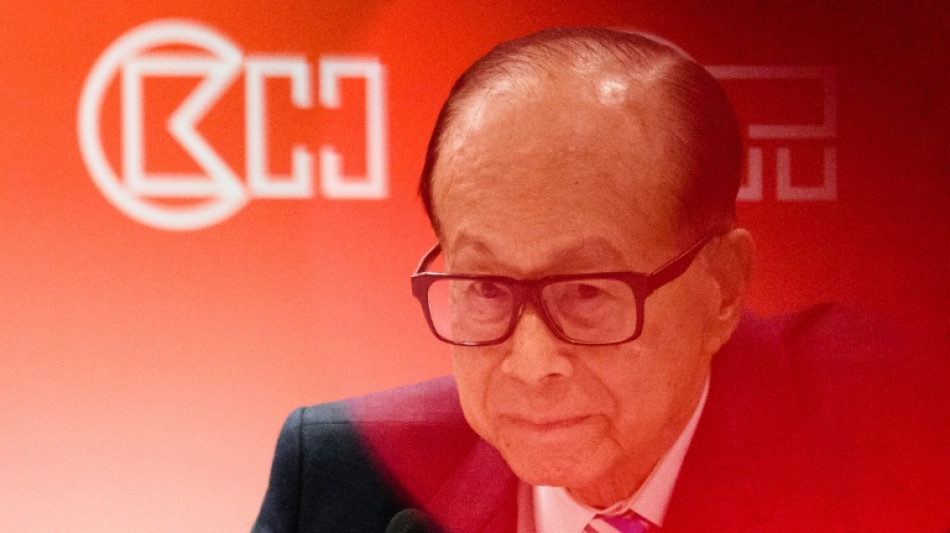
'Superman' Li Ka-shing, Hong Kong billionaire behind Panama ports deal / Photo: ANTHONY WALLACE - AFP/File
Hong Kong tycoon Li Ka-shing and his conglomerate CK Hutchison have been tied up in global US-China rivalry since announcing a controversial $19 billion sale of strategic ports in Panama last year.
The Li family owns 30 percent of CK Hutchison, which controls ports, retail, infrastructure and other businesses in dozens of countries and reported revenue of $61.4 billion in 2024.
Li was Asia's ninth-richest man, according to the Bloomberg Billionaires Index in January, with a total net worth of more than $42 billion.
Nicknamed "Superman" for his business acumen, the 97-year-old and his companies are woven into the fabric of Hong Kong life through everything from internet services to supermarket chains.
A Panama Supreme Court decision to annul CK Hutchison's concession there on Thursday showed how container ports in geopolitically strategic locations have become a prized global currency.
- From refugee to billionaire -
Li was born in the southern Chinese city of Chaozhou in 1928.
A refugee from the Sino-Japanese War who fled mainland China to Hong Kong, he started a business in 1950 manufacturing plastic flowers and named it Cheung Kong after China's Yangtze River.
He reaped big profits in the 1960s after diversifying into property, and extended his businesses into many sectors in the following decades.
Li also had a longstanding interest in overseas markets, making investments in the Canadian property and energy sectors in the 1980s.
He swam against the tide after Beijing crushed the pro-democracy movement in Tiananmen Square in 1989, becoming the largest Hong Kong investor in mainland China, primarily in the property sector, while foreign businesses fled.
He continued to invest heavily on the mainland during the 1990s, the dedicated capitalist courting Beijing's communist leaders as China began to emerge as an economic superpower.
The extent of Li's investments served as a powerful catalyst for foreign capital entering China in the following decades, propelling its economic miracle.
Li also supported China's education and healthcare sectors through substantial philanthropic funding.
He enjoyed close ties with three generations of Chinese leaders, including Deng Xiaoping, the architect of China's economic opening up.
- Weakening ties -
That closeness to China's leadership weakened after Xi Jinping took power in 2012.
Beijing hardened its stance towards tycoons under Xi, including those from Hong Kong, and Li found his commercial and political manoeuvres under increasing criticism by government-affiliated media.
He has offloaded major property investments in China in recent years in a move seen as part of a quest for stability and a sign of being less reliant on the mainland.
Li announced a sweeping reorganisation of his vast business empire in 2015 following the sale of some Chinese assets.
Many of the more recent expansions were instead overseas, with CK Hutchison now operating in some 50 countries across telecoms, ports, infrastructure, and retail.
Li and his family are also reportedly thinking of spinning off and selling assets across its units.
Chinese state media have criticised Li for his apparent decision to divest from some mainland markets and for supposedly showing sympathy to pro-democracy protesters in Hong Kong in 2019.
Beijing authorities intensified pressure on CK Hutchison last year, repeatedly criticising the conglomerate's sale of its Panama Canal ports.
The Beijing-based authority overseeing Hong Kong affairs reposted a newspaper editorial titled "Great entrepreneurs have always been outstanding patriots" after the sale plan was announced in March.
There has been slow progress in the CK Hutchison port sale negotiations since then, with analysts telling AFP that political factors have become a drag.
Panama's Supreme Court found the laws that allowed CK Hutchison to operate two of the five canal ports "unconstitutional", ending its decades-long concession.
The ports operator, CK Hutchison subsidiary Panama Ports Company, said the decision "lacks legal basis" and threatens thousands of livelihoods.
S.Esposito--GdR