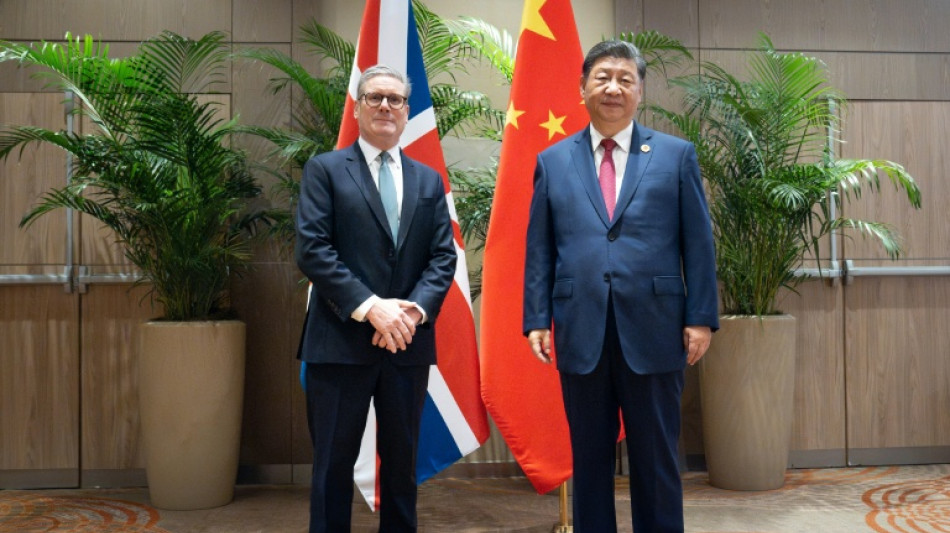
Starmer heads to China to defend 'pragmatic' partnership / Photo: Stefan Rousseau - POOL/AFP
British Prime Minister Keir Starmer begins a three-day visit to China on Wednesday, where he will defend London's "pragmatic" partnership with the Asian giant after years of fraught relations.
It will be the first visit to Beijing by a UK prime minister since 2018 and follows a string of Western leaders courting Beijing in recent weeks, pivoting from a mercurial United States.
Starmer will also make a brief stop in Japan to meet with Prime Minister Sanae Takaichi.
For Chinese President Xi Jinping, the trip is an opportunity to show Beijing can be a reliable partner at a time when President Donald Trump's policies have rattled historic ties between Washington and its Western allies.
Starmer, who is battling record low popularity polls and hopes the visit can boost Britain's beleaguered economy, is to arrive in Beijing around 0930 GMT on Wednesday.
He will meet with Xi for a lunch on Thursday, followed by a meeting with Premier Li Qiang.
The talks will touch upon "trade, investment and national security," Downing Street said in a statement, with Starmer promising "stability and clarity in the government's approach".
Starmer said on Wednesday this visit to China was "going to be a really important trip for us", vowing to make "some real progress".
There are "opportunities" to deepen bilateral relations, Starmer told reporters travelling with him on the plane to China.
"It doesn't make sense to stick our head in the ground and bury in the sand when it comes to China, it's in our interests to engage and not compromise on national security," he added.
China, for its part, "is willing to take this visit as an opportunity to enhance political mutual trust", foreign ministry spokesperson Guo Jiakun said ahead of the trip.
Faced with Trump's threats to impose tariffs on Canada for signing a trade agreement with China, and the US president's attempts to create a new international institution with his "Board of Peace", Beijing has been affirming its support for the United Nations to visiting leaders.
- Reset ties -
UK-China relations plummeted in 2020 after Beijing imposed a sweeping national security law on Hong Kong, which severely curtailed freedoms in the former British colony.
They soured further since with both powers exchanging accusations of spying.
Starmer, however, was quick to deny fresh claims of Chinese spying after the Telegraph newspaper reported Monday that China had hacked the mobile phones of senior officials in Downing Street for several years.
"There's no evidence of that. We've got robust schemes, security measures in place as you'd expect," he told reporters on Wednesday.
Since taking the helm in 2024, Starmer has been at pains to reset ties with the world's second-largest economy and Britain's third-biggest trade partner.
In China, he will be accompanied by around 60 business leaders from the finance, pharmaceutical, automobile and other sectors, and cultural representatives as he tries to balance attracting vital investment and appearing firm on national security concerns.
The Labour leader also spoke to Xi on the sidelines of the G20 summit in Brazil in November 2024.
- Jimmy Lai -
The prime minister is also expected to raise the case of Hong Kong media mogul and democracy supporter Jimmy Lai, 78, a British national facing years in prison after being found guilty of collusion charges in December.
When asked by reporters about his plans to discuss Lai's case, Starmer avoided specifics, but said engaging with Beijing was to ensure that "issues where we disagree can be discussed".
"You know my practice, which is to raise issues that need to be raised," added Starmer, who has been accused by the Conservative opposition of being too soft in his approach to Beijing.
Reporters Without Borders urged Starmer in a letter to secure Lai's release during his visit.
The British government has also faced fierce domestic opposition after it approved this month contentious plans for a new Chinese mega-embassy in London, which critics say could be used to spy on and harass dissidents.
At the end of last year, Starmer acknowledged that China posed a "national security threat" to the UK, drawing flak from Chinese officials.
The countries also disagree on key issues including China's close ties with Russian President Vladimir Putin amid the war in Ukraine, and accusations of human rights abuses in China.
V.Bellini--GdR