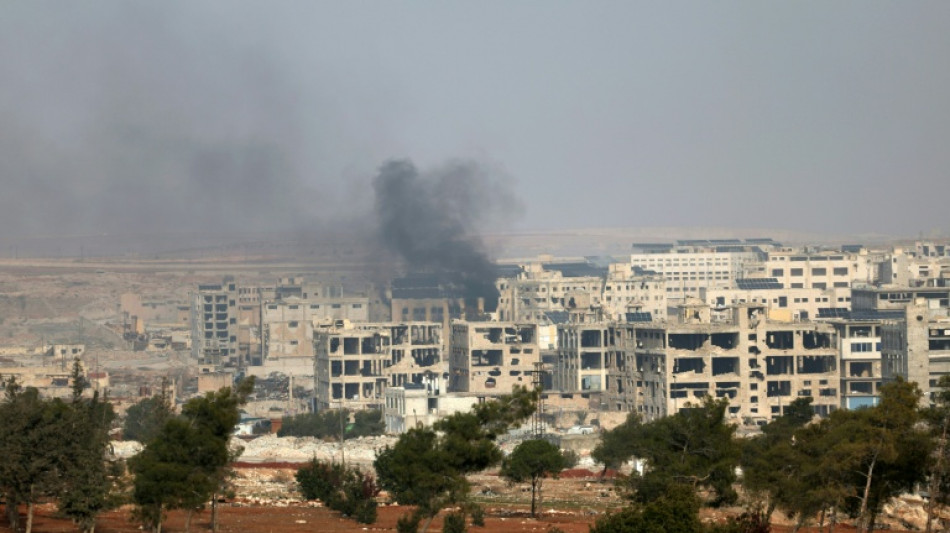
Syria announces ceasefire with Kurdish fighters in Aleppo / Photo: OMAR HAJ KADOUR - AFP
Syria's defence ministry announced a ceasefire in Aleppo on Friday after days of deadly clashes between the army and Kurdish fighters forced thousands of civilians to flee.
The violence killed 21 people and was the latest challenge for a country still struggling to forge a new path after Islamist authorities ousted longtime ruler Bashar al-Assad just over a year ago.
Since Tuesday, government forces have been fighting the US-backed Kurdish-led Syrian Democratic Forces (SDF) in Aleppo, the country's second city.
Both sides have traded blame over who started the fighting, which comes as they struggle to implement a deal to merge the Kurds' administration and military into the country's new government.
The SDF controls swathes of Syria's oil-rich north and northeast, and was key to the territorial defeat of the Islamic State group in Syria in 2019.
"To prevent any slide towards a new military escalation within residential neighbourhoods, the Ministry of Defence announces ... a ceasefire in the vicinity of the Sheikh Maqsud, Ashrafiyeh and Bani Zeid neighbourhoods of Aleppo, effective from 3:00 am," the ministry wrote in a statement.
Kurdish fighters were given until 9:00 am Friday (0600 GMT) to leave those areas, while the Aleppo governorate said Kurdish fighters would be sent, along with their light weapons, to Kurdish areas further east.
The goal of the ceasefire is for civilians who were displaced by the fighting to be able "to return and resume their normal lives in an atmosphere of security and stability", the defence ministry said.
The governor of Aleppo, Azzam al-Gharib, told the official SANA news agency that he had inspected the security arrangements in the Ashrafiyeh neighbourhood.
There was no immediate comment from Kurdish forces in response to the government statements.
The United States welcomed the ceasefire in a post on X by its envoy Tom Barrack.
He said Washington hoped for "a more enduring calm and deeper dialogue" and was "working intensively to extend this ceasefire and spirit of understanding".
- 'No to war' -
An AFP correspondent reported fierce fighting across the Kurdish-majority Ashrafiyeh and Sheikh Maqsud districts into Thursday night.
Syria's military had instructed civilians in those neighbourhoods to leave through humanitarian corridors ahead of launching the operation.
State television reported that around 16,000 people had fled.
"We've gone through very difficult times... my children were terrified," said Rana Issa, 43, whose family left Ashrafiyeh earlier Thursday.
"Many people want to leave", but are afraid of the snipers, she told AFP.
Mazloum Abdi, who leads the SDF, said attacks on Kurdish areas "undermine the chances of reaching understandings", days after he visited Damascus for talks on the March integration deal.
The agreement was meant to be implemented last year, but differences, including Kurdish demands for decentralised rule, have stymied progress.
Sheikh Maqsud and Ashrafiyeh have remained under the control of Kurdish units linked to the SDF, despite Kurdish fighters agreeing to withdraw from the areas in April.
Turkey, which shares a 900-kilometre (550-mile) border with Syria, has launched successive offensives to push Kurdish forces from the frontier.
Aron Lund, a fellow at the Century International research centre, told AFP that "Aleppo is the SDF's most vulnerable area".
"Both sides are still trying to put pressure on each other and rally international support," he said.
He warned that if the hostilities spiral, "a full Damascus-SDF conflict across northern Syria, potentially with Turkish and Israeli involvement, could be devastating for Syria's stability".
Israel and Turkey have been vying for influence in Syria since Assad was toppled in December 2024.
In Qamishli in the Kurdish-held northeast, hundreds of people have protested the Aleppo violence.
"We call on the international community to intervene," said protester Salaheddin Sheikhmous, 61, while others held banners reading "no to war" and "no to ethnic cleansing".
In Turkey, several hundred people joined protests in Kurdish-majority Diyarbakir.
D.Riva--GdR