Canada plow-maker can't clear path through Trump tariffs / Photo: Geoff Robins - AFP
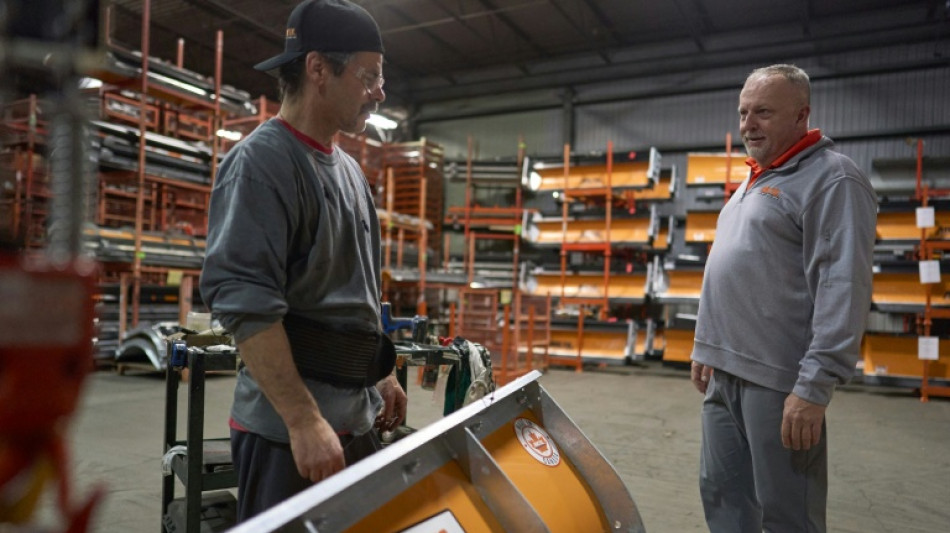
For decades, Arctic Snowplows has sold its Canadian-made galvanized steel products to "anywhere there is snow" across the border in the United States, says company president Mike Schulz.
But a year into President Donald Trump's trade war, some of those customers have been lost, with buyers unwilling to stomach higher prices forced by US tariffs on imported steel.
"Adding an extra $500 (US$363) on the cost of a $10,000 plow, it's a huge hit," Schulz told AFP, as a heavy snow fell outside the company's factory in London, Ontario, 190 kilometers (120 miles) southwest of Toronto.
"It's something we can't afford to just absorb and it's something that customers in the States don't want to pay," Schulz said on the factory floor, surrounded by racks of bright orange plows.
With US sales falling, the company founded in 1969 is facing "very uncertain times," he said.
- 'Global upheaval' -
As the Trump administration heads towards its second year, the majority of US-Canada trade remains tariff free, with the president still broadly adhering to a North American free trade agreement.
But Canada has been hit uniquely hard by Trump's global sectoral tariffs on steel, aluminum, autos and lumber -- due to the interconnected nature of the neighboring economies.
Algoma Steel, one of Canada's largest steel-makers, just announced 1,000 layoffs, blaming the "unprecedented tariffs imposed by the United States."
Bank of Canada Tiff Macklem said last week the changing economic relationship with the United States meant "more than a cyclical downturn."
"It's a structural transition," he said, describing the era as "a period of global upheaval."
Prime Minister Mark Carney has framed US protectionism in similarly stark terms, warning Canadians that pre-Trump economic integration with the United States is not coming back.
To counter Trump's trade war, Carney argues Canada needs to increase domestic trade while pursuing new markets overseas.
In an announcement last month about support for steel and aluminum businesses, Carney said that "to compete and win in this new global environment, these strategic sectors must be ready to seize new markets at home and around the world."
For Arctic Plows, that strategy has limitations.
Schulz said the company's Canadian business has picked up, partly thanks to surges in patriotic buying inspired by Trump's trade war and earlier threats to make Canada the 51st US state.
But Canadian sales are only a "fraction" of what the company has historically made in the United States, he said.
"Great, so I picked up a dealer in Saskatoon, but I lost New York. I mean, awesome, I love the patriotism, but the volume offset is just not there."
The company's sales development manager, Kyla Brooks, stressed the delicacy of a marketing strategy that seeks to capitalize on buy-Canadian momentum.
"We have to be somewhat careful in our messaging," she told AFP, noting Arctic can't risk alienating its remaining US customers by leaning too hard into "that pro-Canadian message."
Schulz also chuckled at the notion that a cure for his challenges could be found overseas.
"Look at the size of the product. You can say great, we're gonna ship this to Europe...If we do, it's going to be a pretty expensive boat(ride)," he said.
- 'Extremely frustrated' -
Schulz also made clear that he was uncomfortable with Carney's apparent negotiating strategy.
The prime minister was elected to a full term in April by voters who viewed the former central banker as the strongest candidate to lead Canada through a trade war.
Carney has rolled back many of Canada's counter-tariffs on US imports, a tactic partly aimed at coaxing Trump towards a deal.
But the president has called off all trade negotiations with Canada out of anger over an anti-tariff ad produced by Ontario's provincial government.
Schulz said that sequence had left him "extremely frustrated."
Counter-tariffs that partly levelled the playing field with his US competitors are gone while Canadian businesses "have no indication of any deal upcoming," he said.
The president of the Canadian Steel Producers Association, Catherine Cobden, told AFP that 2025 was a "challenging year."
"The United States was the destination for approximately half our production," she said, voicing hope that with government anti-dumping measures, Canada can "reclaim our domestic market."
G.Bianchi--GdR