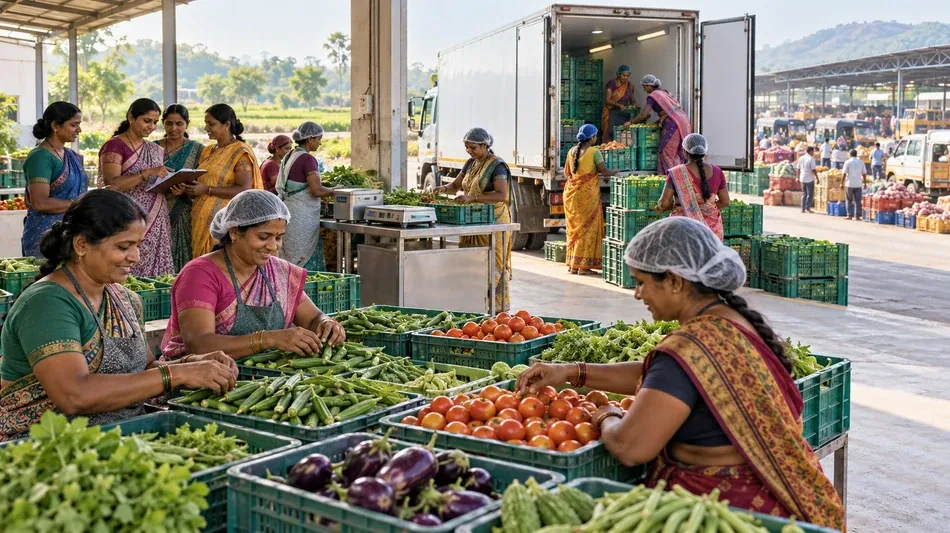
Industry Groups Outline Four Steps to Help Women Farmers Reach Markets
The Solvent Extractors’ Association of India and Solidaridad proposed four measures aimed at improving women farmers’ access to formal agricultural markets.
The Solvent Extractors’ Association of India and Solidaridad proposed four measures aimed at improving women farmers’ access to formal agricultural markets.
The Solvent Extractors’ Association of India (SEA) and Solidaridad have proposed four measures to strengthen women farmers’ access to formal markets, improve price realisation and enhance their financial inclusion across vegetable oil value chains.
The recommendations emerged from a multi-stakeholder dialogue and consultation on ‘Scaling gender-inclusive regenerative vegetable oil value chains: A policy roadmap’ in Bhopal. The consultation emphasised the need to translate women’s contributions to agriculture into greater economic recognition, control over income, and meaningful participation in formal supply chains.
4 priority measures
The consultation identified four priority measures for policymakers and industry stakeholders.
The priority measure called for introducing defined procurement targets for agricultural produce sourced directly from women farmers. Such measures can expand their access to organised markets, corporate sourcing networks and formal supply chains.
The next measure stressed the need to explore preferential pricing mechanisms or premiums for produce supplied by women farmers, recognising their contributions to sustainable agricultural practices and encouraging participation in regenerative agriculture programmes.
The third measure centred on encouraging payment arrangements that strengthen women’s financial inclusion and control over agricultural earnings. Where appropriate, joint bank account arrangements may be promoted with the informed consent of the account holders, alongside other mechanisms that enable payments to reach women farmers directly.
The fourth priority measure called for companies to allocate at least 10 per cent of their corporate social responsibility budgets, subject to applicable laws, to integrate women farmers into supply chains through capacity building, regenerative agriculture, market linkages and technology access.
Reflecting it better
Quoting BV Mehta, Executive Director of SEA, a media statement stated women farmers are integral to India’s agricultural and vegetable oil value chains, contributing across production, processing and rural livelihoods. nevertheless, markets must better reflect their contributions in access, price realisation, and economic decision-making.
“Through our collaboration with Solidaridad, SEA seeks to encourage industry stakeholders to adopt practical measures, among them dedicated procurement from women farmers, fair price incentives and inclusive payment mechanisms. Building gender-inclusive supply chains is not only a matter of equity; it is also essential to developing a stronger, more sustainable and resilient vegetable oil sector,” he stated.
Suresh Motwani, General Manager of Solidaridad, stated empowering women farmers requires moving beyond training and awareness to addressing the structural barriers that constrain their economic participation. Women need equitable access to markets, fair returns for their produce, greater financial independence and opportunities to participate in decisions affecting their livelihoods. “Through our collaboration with SEA, we aim to work with industry, policymakers, farmer institutions and civil society to embed gender inclusion within regenerative agriculture and vegetable oil value chains. The recommendations emerging from this dialogue offer a pathway to translate commitments into measurable action, delivering lasting benefits for women farmers, their families and rural communities,” he stated.
Neha, Assistant General Manager of Solidaridad, stated recognising women as farmers, regardless of land ownership, can strengthen their access to institutional support, enhance economic independence and promote more inclusive agricultural value chains.
F.Piras--GdR